
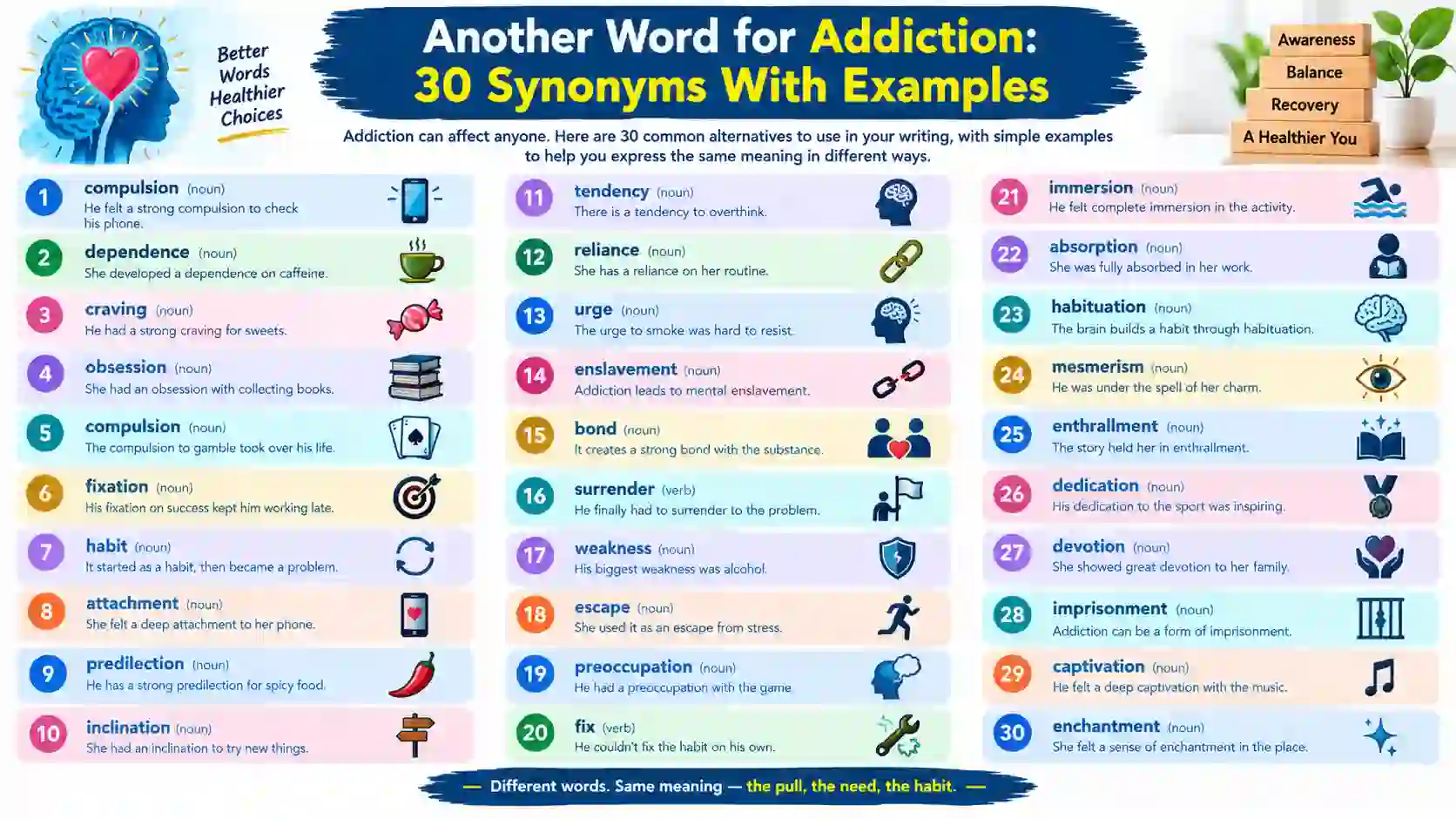
The closest everyday alternatives to addiction are dependence, dependency, habit, compulsion, and craving. In medical or formal writing, substance use disorder and chemical dependency are common choices. Each word carries a slightly different meaning.
The best alternative depends on what you mean. Addiction can describe a serious health problem with drugs, alcohol, or gambling. It can also describe a strong obsession or, in casual speech, a love of something, like coffee or a TV show. Some words fit the serious meaning. Others fit only the light, informal one.
Quick list: dependence, dependency, habit, compulsion, craving, obsession, fixation, chemical dependency, substance use disorder, weakness
This article looks at 30 alternatives. For each one, you will find a meaning, IPA pronunciation, usage note, and example sentence, along with context for choosing the right word.
At a Glance: Addiction Synonyms and Related Alternatives
| Alternative | Part of Speech | Meaning | Register / Tone | Ideal Context |
| Dependence | Noun | Needing something to function or feel normal | Neutral, formal | Health, medicine, general writing |
| Habit | Noun | A repeated behavior done almost without thinking | Neutral, everyday | Daily routines, mild or harmful behaviors |
| Compulsion | Noun | A strong urge that is hard to resist | Neutral, clinical | Behavior, psychology |
| Craving | Noun | An intense desire for something | Neutral | Food, drugs, cigarettes, comfort |
| Obsession | Noun | Constant thinking about one thing | Neutral | Thoughts, hobbies, relationships |
| Chemical dependency | Noun phrase | Dependence on a drug or alcohol | Formal, clinical | Treatment, health writing |
| Substance use disorder | Noun phrase | A medical condition involving harmful substance use | Formal, medical | Diagnosis, research, policy |
| Fixation | Noun | An unhealthy focus on one thing | Neutral, psychological | Obsessive interests |
| Weakness | Noun | A strong liking you struggle to resist | Informal, light | Sweets, shopping, small indulgences |
| Penchant | Noun | A strong liking or tendency | Formal, positive | Tastes and preferences |
Which Word Should You Use?
| If you want to… | Use | Why |
| Describe a serious drug or alcohol problem in a medical setting | Substance use disorder | It is the current clinical term. |
| Talk about the body needing a substance | Dependence | It stresses reliance, not just desire. |
| Describe a repeated behavior that may or may not be harmful | Habit | It is the mildest and most flexible choice. |
| Describe an urge that feels impossible to resist | Compulsion | It points to the loss of control. |
| Describe an intense wish for something | Craving | It focuses on desire, not ongoing dependence. |
| Say someone cannot stop thinking about something | Obsession | It is about thoughts, not only actions. |
| Joke about a small indulgence | Weakness | It sounds light and friendly. |
| Describe a strong, healthy interest | Passion | It has a positive tone that “addiction” lacks. |
Exploring the Multiple Meanings of “Addiction”
1. Compulsive Need for a Substance
- Meaning: A chronic, compulsive need for a habit-forming substance, such as alcohol, nicotine, or drugs.
- Explanation: This is the main medical and everyday meaning. The person keeps using the substance even when it causes harm. It differs from simple dependence. Some people depend on a medicine physically without being addicted, because addiction involves compulsive use despite harm.
- Example: Her addiction to painkillers began after a back injury.
2. Compulsive Behavior
- Meaning: A strong, repeated urge to do an activity, even when it causes harm.
- Explanation: Gambling is the best-known example, and health bodies also recognize problem gaming. Other uses, such as “shopping addiction,” are less formal, and experts debate which behaviors count as true addictions.
- Example: His gambling addiction cost him his savings.
3. Strong Enthusiasm or Obsession (Informal)
- Meaning: A very strong liking for something, often said with humor.
- Explanation: In casual speech, people use “addiction” for harmless habits. This use is exaggerated and not medical.
- Example: My addiction to true-crime podcasts is getting out of hand.
4. Devotion or Strong Inclination (Formal or Older Use)
- Meaning: A deep attachment to a practice, interest, or way of life.
- Explanation: This sense reflects the word’s Latin roots in “devoting” oneself to something. It is rare today and can sound old-fashioned. Dictionaries list it as a less common sense.
- Example: The scholar’s addiction to study left little time for friends.
Sources: Merriam-Webster; Collins English Dictionary; Dictionary.com; National Institute on Drug Abuse (NIDA); American Psychiatric Association.
Analyzing 30 Addiction Alternatives in Detail
Some alternatives below are direct synonyms, while others are related words that fit only certain contexts. The usage notes say which is which.
Core Everyday Alternatives
1. Dependence
IPA: /dɪˈpɛndəns/ (US and UK)
Definition: The state of needing something or someone for support or to function normally.
- Usage: A close synonym in health contexts. It stresses need, and it is less judgmental than “addiction.” Medically, dependence and addiction are not always the same thing.
- Example: Doctors warned him about his growing dependence on sleeping pills.
2. Dependency
IPA: /dɪˈpɛndənsi/ (US and UK)
Definition: A state of relying on a substance, person, or thing.
- Usage: A near-synonym of “dependence,” often used in clinical or social-work language. It can also describe non-drug reliance, so context matters.
- Example: The clinic helps people with alcohol dependency.
3. Habit
IPA: /ˈhæbɪt/ (US and UK)
Definition: A behavior repeated so often that it becomes automatic.
- Usage: A related alternative, not an exact synonym. A habit may be harmless, and addiction is much stronger and harder to stop. People often say “drug habit” or “smoking habit” for a milder, everyday tone.
- Example: Biting her nails was a habit she could not shake.
4. Compulsion
IPA: /kəmˈpʌlʃən/ (US and UK)
Definition: A strong, repeated urge to do something that is hard to resist.
- Usage: A close alternative when the focus is loss of control. It is common in psychology. It describes the urge, while addiction usually describes the whole condition.
- Example: He felt a compulsion to check his phone every few minutes.
5. Craving
IPA: /ˈkreɪvɪŋ/ (US and UK)
Definition: An intense desire for something.
- Usage: A related alternative. A craving is one part of addiction, but people also have food cravings without being addicted.
- Example: Cravings for cigarettes are strongest in the first week after quitting.
6. Reliance
IPA: /rɪˈlaɪəns/ (US and UK)
Definition: The state of depending on something for help or support.
- Usage: A weaker, more general alternative. It works for substances only when the writer wants a neutral tone. It does not suggest compulsion or harm by itself.
- Example: Her reliance on caffeine grew during exam season.
Medical and Formal Terms
7. Chemical dependency
IPA: /ˈkɛmɪkəl dɪˈpɛndənsi/ (US and UK)
Definition: A condition in which a person depends on a drug or alcohol.
- Usage: A direct synonym for substance addiction. It sounds clinical and appears in treatment and health writing. It does not cover behavioral addictions like gambling.
- Example: The center offers programs for chemical dependency.
8. Substance use disorder
IPA: US /ˈsʌbstəns juːs dɪsˈɔːrdər/ · UK /ˈsʌbstəns juːs dɪsˈɔːdə/
Definition: A medical condition in which a person’s use of alcohol or drugs causes health problems or trouble at work, school, or home.
- Usage: The current medical term, used in psychiatry and public health. It covers a range from mild to severe, and “addiction” generally refers to the severe end.
- Example: She was diagnosed with a moderate substance use disorder.
9. Substance abuse
IPA: /ˈsʌbstəns əˈbjuːs/ (US and UK)
Definition: The harmful or excessive use of drugs or alcohol.
- Usage: A related term, not an exact synonym. It describes the behavior, while addiction describes the condition. Many health professionals now prefer “substance use disorder” because “abuse” can sound judgmental.
- Example: The school runs a program on substance abuse prevention.
10. Alcoholism
IPA: US /ˈælkəˌhɔːlɪzəm/ · UK /ˈælkəhɒlɪzəm/
Definition: A long-term condition marked by a strong need to drink alcohol and a loss of control over drinking.
- Usage: A specific type of addiction, not a general synonym. Use it only when the substance is alcohol.
- Example: His father’s alcoholism shaped the family’s history.
11. Habituation
IPA: /həˌbɪtʃuˈeɪʃən/ (US and UK)
Definition: The process of becoming used to something through repeated exposure.
- Usage: A technical, related term. In medicine, it can describe getting used to a drug. It is much weaker than addiction and is not a normal everyday synonym.
- Example: Habituation to the medicine meant she needed larger doses.
Obsession and Fixation
12. Obsession
IPA: /əbˈsɛʃən/ (US and UK)
Definition: A constant, strong preoccupation with one thought, person, or activity.
- Usage: A close alternative for non-substance addiction, especially when the focus is on thoughts. It can describe something harmful or simply intense.
- Example: His obsession with winning ruined his friendships.
13. Fixation
IPA: /fɪkˈseɪʃən/ (US and UK)
Definition: An unhealthy or excessive focus on one person or thing.
- Usage: A related alternative that stresses stuck attention. It is milder than obsession and sounds more critical.
- Example: Her fixation on the latest gadgets worried her parents.
14. Preoccupation
IPA: US /priˌɑːkjəˈpeɪʃən/ · UK /priˌɒkjʊˈpeɪʃən/
Definition: The state of being so absorbed in something that you give little attention to other things.
- Usage: A formal, related alternative. It is much gentler than addiction and does not suggest loss of control.
- Example: His preoccupation with work kept him away from home.
15. Infatuation
IPA: /ɪnˌfætʃuˈeɪʃən/ (US and UK)
Definition: A strong but often short-lived passion or admiration for someone or something.
- Usage: A related alternative used mainly for people, trends, or new interests. It suggests excitement that may fade, so it is not a real synonym for addiction.
- Example: Her infatuation with video games lasted one summer.
16. Mania
IPA: /ˈmeɪniə/ (US and UK)
Definition: An extreme enthusiasm or craze for something.
- Usage: A related, dramatic alternative. In medicine, “mania” also names a mood state, so keep that sense in mind. In general use, it suggests a wild or widespread craze.
- Example: The country caught a collecting mania for rare coins.
Strong Liking and Informal Alternatives
17. Weakness
IPA: /ˈwiːknəs/ (US and UK)
Definition: A strong liking for something that is hard to resist.
- Usage: A light, informal alternative for mild indulgences. It is not suitable for serious addiction, because it can sound like it makes light of a real problem.
- Example: Chocolate is my biggest weakness.
18. Passion
IPA: /ˈpæʃən/ (US and UK)
Definition: A very strong feeling of enthusiasm or interest in something.
- Usage: A positive alternative for informal uses of “addiction.” Use it when you want to remove the idea of harm.
- Example: Cooking became her passion after she retired.
19. Penchant
IPA: /ˈpɛntʃənt/ (US and UK)
Definition: A strong liking or habit of doing something.
- Usage: A formal, positive or neutral alternative. It never suggests harm, so it fits only the informal “strong liking” sense.
- Example: He has a penchant for old detective novels.
20. Appetite
IPA: /ˈæpɪtaɪt/ (US and UK)
Definition: A strong desire for something, not only food.
- Usage: A figurative alternative. It works in phrases like “appetite for risk” and suggests a natural, ongoing desire.
- Example: The company has an appetite for new challenges.
21. Yen
IPA: /jɛn/ (US and UK)
Definition: A strong desire or inclination.
- Usage: An informal, related alternative. It usually describes a sudden want, as in “a yen for sweets,” not a long-term problem.
- Example: She had a sudden yen for fresh mangoes.
22. Jones
IPA: US /dʒoʊnz/ · UK /dʒəʊnz/
Definition: A strong craving or habit, especially for a drug (slang).
- Usage: Informal, mostly American slang. It can mean a drug addiction or a strong desire. Avoid it in formal writing.
- Example: He’s got a real jones for fast cars.
Control and Bondage Terms
23. Enslavement
IPA: /ɪnˈsleɪvmənt/ (US and UK)
Definition: The state of being controlled by something.
- Usage: A figurative, strong alternative. It stresses how addiction takes control. It can sound dramatic and is not a medical term.
- Example: The book describes his enslavement to gambling.
24. Bondage
IPA: US /ˈbɑːndɪdʒ/ · UK /ˈbɒndɪdʒ/
Definition: The state of being controlled by a force or habit.
- Usage: A literary or religious alternative used figuratively. It is rare in everyday speech and has other meanings, so context must be clear.
- Example: He spoke about his bondage to alcohol and how he escaped it.
25. Thrall
IPA: /θrɔːl/ (US and UK)
Definition: A state of being under the power of someone or something.
- Usage: A literary term, almost always used in the phrase “in thrall to.” It is not a direct synonym, and it works only as a figurative alternative.
- Example: For years he lived in thrall to his phone.
Devotion, Inclination, and Vice
26. Devotion
IPA: US /dɪˈvoʊʃən/ · UK /dɪˈvəʊʃən/
Definition: Great love or loyalty toward a person, activity, or cause.
- Usage: Matches the older, formal sense of addiction as strong attachment. It is positive and does not suggest harm.
- Example: Her devotion to music began in childhood.
27. Inclination
IPA: /ˌɪnklɪˈneɪʃən/ (US and UK)
Definition: A natural tendency or leaning toward something.
- Usage: A formal, mild alternative. It suits the old sense of addiction as a tendency, but it is much weaker than the modern meaning.
- Example: He had a strong inclination toward risky hobbies.
28. Proclivity
IPA: US /proʊˈklɪvəti/ · UK /prəˈklɪvɪti/
Definition: A natural tendency to do something, often something negative.
- Usage: A formal, related alternative. It suggests a built-in leaning, not an active dependence.
- Example: The study looked at a proclivity for risky behavior in teenagers.
29. Attachment
IPA: /əˈtætʃmənt/ (US and UK)
Definition: A feeling of closeness or strong connection to something.
- Usage: A soft, general alternative. It is far weaker than addiction, but it can work when you describe emotional reliance.
- Example: Her attachment to her old routines made change hard.
30. Vice
IPA: /vaɪs/ (US and UK)
Definition: A bad habit or moral fault, often involving a harmful indulgence.
- Usage: A related alternative with a moral tone. People call smoking or gambling a “vice,” but the word is judgmental and does not describe a medical condition.
- Example: Gambling was his only vice.
Sources: Merriam-Webster; Collins English Dictionary and Collins Thesaurus; Dictionary.com; Oxford Learner’s Dictionaries; Cambridge Dictionary; NIDA.
Addiction vs. Dependence vs. Habit vs. Obsession
These four words overlap, but each points to something different.
| Word | Focus | Harm Involved? | Typical Use |
| Addiction | Compulsive use or behavior despite harm | Usually yes | Drugs, alcohol, gambling |
| Dependence | The body or mind needing something | Not always | Medicines, caffeine, substances |
| Habit | A repeated, automatic behavior | Not always | Everyday routines |
| Obsession | Constant, hard-to-stop thoughts | Often | Thoughts, hobbies, people |
A person can be physically dependent on a medicine without being addicted to it. A habit becomes closer to an addiction when the person cannot stop even though it causes real harm. Obsession often describes the mind, while addiction often describes behavior.
Sources: NIDA; American Psychiatric Association; Merriam-Webster; Collins English Dictionary.
Addiction and Opposite/Paired Word Pairs
| Word | Paired Word | Note |
| Addiction | Recovery | The most common pairing, describing the process of getting better. |
| Addiction | Sobriety | Used for freedom from alcohol or drugs. |
| Addiction | Abstinence | Means choosing to avoid a substance or behavior completely. |
| Addiction | Moderation | Describes controlled, balanced use. |
| Dependence | Independence | A natural opposite. |
| Habit | Break | A common pairing: you break a habit. |
| Craving | Satisfaction | Describes a desire being met. |
| Compulsion | Self-control | Contrasts an urge with the power to resist it. |
Addiction has no single perfect opposite. “Recovery” and “sobriety” describe the outcome, while “moderation” and “self-control” describe healthy behavior. Pick the pair that matches the context.
Sources: Merriam-Webster; Collins Thesaurus; Dictionary.com; NIDA.
Common Word Partners of “Addiction”
| Pattern | Common Partners | Example |
| Type + addiction | drug, alcohol, gambling, nicotine, opioid | Opioid addiction affects many families. |
| Modern uses | smartphone, internet, gaming | She worried about her son’s gaming addiction. |
| Verb + addiction | overcome, treat, beat, develop, fight | He worked for years to overcome his addiction. |
| Addiction + noun | treatment, recovery, counselor, specialist | An addiction counselor met with the group. |
| Addiction + to | addiction to alcohol, addiction to sugar | Her addiction to sugar was hard to break. |
| Adjective + addiction | serious, severe, long-term, hidden | He hid a severe addiction for years. |
| Verb + a addiction | feed, fuel, support | The cost of feeding his addiction kept rising. |
Sources: Collins English Dictionary; Oxford Learner’s Dictionaries; Cambridge Dictionary; Merriam-Webster.
Idiomatic Phrases Featuring “Addiction”
The word “addiction” itself appears in very few fixed idioms. The expressions below are established ways to talk about addiction and its symptoms. None of them contains the word itself, and some are informal.
1. Hooked on
- Meaning: Strongly attached to something, or addicted to it.
- Example: She got hooked on cigarettes in college.
2. A monkey on one’s back
- Meaning: A serious problem, especially a drug addiction, that is hard to get rid of.
- Example: He finally got the monkey off his back after two years of treatment.
3. Kick the habit
- Meaning: To stop doing something harmful, especially smoking or using drugs.
- Example: Many people try several times before they kick the habit.
4. Cold turkey
- Meaning: Stopping a habit or drug suddenly, without gradual reduction.
- Example: He quit coffee cold turkey and had headaches for days.
Sources: Merriam-Webster; Collins English Dictionary; Cambridge Dictionary; Dictionary.com.
Word Formation of “Addiction”
Etymology & Structure
“Addiction” comes from the Latin addictio (“a giving over”), which comes from addicere (“to assign, give over, devote”). The Latin verb joins ad- (“to”) and dicere (“to say”). The English noun has three parts: ad- + dict + -ion.
Date and History
Dictionaries trace the English word to the late 1500s or early 1600s, and the exact year differs by source. The early meaning was “devotion” or “strong inclination,” not harm. The modern sense of compulsive need for a drug became common in the early 1900s.
Word Class Variations
- Noun: addiction, a person experiencing addiction, addictiveness
- Verb: to experience addiction, to develop an addiction
- Adjective: addicted, addictive, addicting (mainly American English)
- Adverb: addictively
Sources: Etymonline; Merriam-Webster; Collins English Dictionary; Dictionary.com.
Common Word-Choice Mistakes
- “Addiction of alcohol”: use addiction to alcohol.
- “I’m addicted with coffee”: use addicted to coffee.
- “He has a habit addiction”: use a habit or an addiction, not both.
- “She has a weakness to cake”: use a weakness for cake.
- “A penchant of art”: use a penchant for art.
- “He cured his addiction fast”: use overcame or recovered from, since cured suggests a quick fix that rarely applies.
Frequently Asked Questions
What is the closest synonym for addiction?
“Dependence” is the closest everyday synonym, especially in health contexts. “Dependency” and “chemical dependency” also work.
What is a formal word for addiction?
“Substance use disorder” is the formal medical term for drug and alcohol problems. “Dependence” and “compulsion” also sound formal.
What is the difference between addiction and habit?
A habit is a repeated behavior that may be harmless. Addiction involves a compulsive urge and continues despite harm.
Is dependence the same as addiction?
Not always. A person can depend physically on a medicine without being addicted. Addiction also involves compulsive use despite harm.
What is an informal word for addiction?
“Weakness,” “jones,” and “yen” are informal. They are best for light, everyday uses, not serious health problems.
What is a figurative alternative to addiction?
“Thrall,” “enslavement,” and “bondage” are figurative. They stress being controlled by something.
What is the opposite of addiction?
There is no single opposite. “Recovery,” “sobriety,” and “moderation” are common contrasts, depending on the meaning.
Can addiction be used for non-substances?
Yes. People use it for gambling, gaming, and other repeated behaviors. Health experts disagree about which behaviors count as addictions.
Can addiction mean a strong liking?
Yes, informally. “My addiction to tea” is a playful exaggeration, not a medical claim. “Passion” or “weakness” may fit better.
Conclusion
The closest alternatives to addiction are dependence, dependency, habit, compulsion, and craving. In medical writing, “substance use disorder” and “chemical dependency” are clearer, more precise options.
Context matters because these words do not all mean the same thing. A habit may be harmless, a craving is only a desire, and an obsession focuses on thoughts. Medical terms suit serious conditions, while softer words like “weakness” and “passion” suit light uses.
To choose the right word, first decide if you mean a serious condition, a repeated behavior, or a strong liking. Then match the word’s tone to your audience. When in doubt, pick the more neutral word, especially if the topic is sensitive.

Ibadat Fatima is a professional content writer with 3 years of experience in English vocabulary, synonyms, word meanings, and language learning. Through ideamoonhavan.com, she creates clear, accurate, and easy-to-understand content that helps readers expand their vocabulary and communicate in English with confidence.