Have you ever written “I will ensure the work is done” and felt the word was boring? You are not alone. Many writers use the same word again and again. Here is a simple example. A student writes, “I will ensure my essay is neat.” It works, but it sounds flat. Better words exist! “Ensure” means to make sure something happens. It is a small word with a big job. That is why synonyms for ensure are so helpful. Students can use them in essays. Bloggers and content writers can use them to keep posts fresh. Daily English users can sound clear and confident. In this guide, you will learn 50 strong synonyms for ensure, with easy meanings and real examples. Pick your favorites and start using them today. Guarantee Meaning: To promise that something will surely happen. Examples: Assure Meaning: To tell someone that everything will be okay. Examples: Secure Meaning: To get something safely so that it will not be lost. Examples: Confirm Meaning: To say that something is true or will happen. Examples: Verify Meaning: To check that something is true or correct. Examples: Certify Meaning: To officially say that something is true or good enough. Examples: Make sure Meaning: To check or act so that something happens. Examples: Safeguard Meaning: To keep something safe from harm. Examples: Protect Meaning: To keep someone or something from getting hurt. Examples: Guard Meaning: To watch over something so it stays safe. Examples: Warrant Meaning: To give a good reason or a promise that something is true. Examples: Promise Meaning: To say you will surely do something. Examples: Pledge Meaning: To make a strong and serious promise. Examples: Vouch Meaning: To say that you believe something or someone is good. Examples: Validate Meaning: To show that something is correct or real. Examples: Establish Meaning: To set up something firmly so it lasts. Examples: Settle Meaning: To fix something so there is no more doubt. Examples: Clinch Meaning: To finally win or make something certain. Examples: Seal Meaning: To make something final and sure. Examples: Lock in Meaning: To fix something so it cannot change. Examples: Arrange Meaning: To plan something so it will happen. Examples: See to it Meaning: To take care that something gets done. Examples: Check Meaning: To look at something to be sure it is right. Examples: Insure Meaning: To pay money so you are protected if something goes wrong. Examples: Underwrite Meaning: To agree to pay for something so it can go ahead. Examples: Back Meaning: To support something so it can succeed. Examples: Endorse Meaning: To say in public that you support something. Examples: Authenticate Meaning: To prove that something is real. Examples: Corroborate Meaning: To give more proof that something is true. Examples: Substantiate Meaning: To give proof for a claim. Examples: Affirm Meaning: To say firmly that something is true. Examples: Bolster Meaning: To make something stronger or more sure. Examples: Reinforce Meaning: To add strength to something. Examples: Strengthen Meaning: To make something stronger. Examples: Uphold Meaning: To keep a rule or promise alive. Examples: Maintain Meaning: To keep something in good shape. Examples: Preserve Meaning: To keep something from being lost or spoiled. Examples: Sustain Meaning: To keep something going over time. Examples: Ratify Meaning: To approve something in an official way. Examples: Finalize Meaning: To finish something so it is ready. Examples: Ascertain Meaning: To find out something for sure. Examples: Determine Meaning: To find out or decide something for sure. Examples: Cement Meaning: To make something strong and lasting. Examples: Fortify Meaning: To make something strong against danger. Examples: Shield Meaning: To keep something safe from harm. Examples: Defend Meaning: To protect something from attack or loss. Examples: Attest Meaning: To say or show that something is true. Examples: Prove Meaning: To show that something is true. Examples: Make certain Meaning: To act so you are one hundred percent sure. Examples: Take care to Meaning: To be careful so something happens the right way. Examples: Enforce Meaning: To make people follow a rule. Examples: Conclusion Learning synonyms for ensure does more than add new words. It makes your writing sharper, your blog posts more interesting, and your speaking clear and confident. Better words also help people understand you faster, and that is the heart of good communication. Start small. Pick three words from this list and use them this week. Try them in an email, an essay, or a chat with a friend. With practice, they will feel natural, and you will never feel stuck with “ensure” again! Ibadat FatimaIbadat Fatima is a professional content writer with 3 years of experience in English vocabulary, synonyms, word meanings, and language learning. Through ideamoonhavan.com, she creates clear, accurate, and easy-to-understand content that helps readers expand their vocabulary and communicate in English with confidence.

Synonyms for Large: 50 Powerful Words to Use Instead of Large
Have you ever typed “the large house” three times in one email? It feels boring, right? Your reader feels it too. Large means big in size, amount, or power. A large pizza can feed a whole family. A large crowd can fill a street. Knowing synonyms for large helps you pick a better word every time. Students use them to write stronger essays. Bloggers and content writers use them to keep posts fresh. Daily English users sound clearer and more confident. This list gives you 50 useful synonyms for large. Each one has a simple meaning and two easy examples. Read them slowly. Pick your favorites. Then use them today. Big Meaning: Examples: Huge Meaning: Examples: Enormous Meaning: Examples: Giant Meaning: Examples: Gigantic Meaning: Examples: Massive Meaning: Examples: Immense Meaning: Examples: Vast Meaning: Examples: Great Meaning: Examples: Grand Meaning: Examples: Colossal Meaning: Examples: Mammoth Meaning: Examples: Tremendous Meaning: Examples: Towering Meaning: Examples: Jumbo Meaning: Examples: Spacious Meaning: Examples: Extensive Meaning: Examples: Substantial Meaning: Examples: Sizable Meaning: Examples: Hefty Meaning: Examples: Bulky Meaning: Examples: Whopping Meaning: Examples: Monumental Meaning: Examples: Titanic Meaning: Examples: Gargantuan Meaning: Examples: Mighty Meaning: Examples: Broad Meaning: Examples: Wide Meaning: Examples: Tall Meaning: Examples: Ample Meaning: Examples: Major Meaning: Examples: Considerable Meaning: Examples: Generous Meaning: Examples: Roomy Meaning: Examples: Hulking Meaning: Examples: Monstrous Meaning: Examples: Epic Meaning: Examples: Oversized Meaning: Examples: King-size Meaning: Examples: Humongous Meaning: Examples: Stupendous Meaning: Examples: Prodigious Meaning: Examples: Expansive Meaning: Examples: Voluminous Meaning: Examples: Capacious Meaning: Examples: Outsized Meaning: Examples: Heavy Meaning: Examples: Full-size Meaning: Examples: Large-scale Meaning: Examples: Astronomical Meaning: Examples: Conclusion Learning synonyms is a simple way to grow your English. Strong word choice makes your writing clear and your blog posts more fun to read. It also helps you sound confident when you speak. You do not need to learn all 50 words today. Pick five and try them in an email, an essay, or a chat with a friend. Small steps build strong habits. Keep practicing, and soon these synonyms will feel natural. Raheela RaniRaheela Rani is a professional content writer with 3 years of experience in English vocabulary, synonyms, word meanings, and language learning. Through ideamoonhavan.com, she creates clear, accurate, and easy-to-understand content that helps readers expand their vocabulary and use English with confidence.

Synonyms for Dark: 50 Easy Words with Meanings and Examples
You walk into your room at night. The lights are off. You say, “It is so dark in here!” The next day, you say it again about a movie, a mood, and a color. Sound familiar? Dark means with little or no light. It can also mean a deep color, a sad feeling, or a secret. That is why synonyms for dark are so helpful. Students use them to make essays stronger. Bloggers and content writers use them to avoid repeating one word. Daily English users use them to sound clear and fun. In this guide, you will learn 50 synonyms for dark. Each word has a simple meaning and two short examples. Let’s light up your vocabulary! Dim Meaning: Dim means not bright, with only a little light. Examples: Gloomy Meaning: Gloomy means dark and a little sad. Examples: Shadowy Meaning: Shadowy means full of shadows. Examples: Dusky Meaning: Dusky means a little dark, like the sky after sunset. Examples: Murky Meaning: Murky means dark and hard to see through. Examples: Pitch-Black Meaning: Pitch-black means so dark that you see nothing. Examples: Black Meaning: Black means having no light or no color at all. Examples: Unlit Meaning: Unlit means having no lights turned on. Examples: Shady Meaning: Shady means dark and cool because something blocks the sun. Examples: Dingy Meaning: Dingy means dark, dirty, and old-looking. Examples: Somber Meaning: Somber means dark in color or serious and sad in feeling. Examples: Sunless Meaning: Sunless means without any sunshine. Examples: Overcast Meaning: Overcast means covered with gray clouds. Examples: Cloudy Meaning: Cloudy means full of clouds, so the sky looks dark. Examples: Moonless Meaning: Moonless means a night with no moon in the sky. Examples: Starless Meaning: Starless means a night sky with no stars. Examples: Inky Meaning: Inky means very dark, like ink. Examples: Jet-Black Meaning: Jet-black means a very deep, shiny black. Examples: Ebony Meaning: Ebony means a deep, rich black color. Examples: Sooty Meaning: Sooty means black from smoke or ash. Examples: Obscure Meaning: Obscure means hard to see because it is dark or hidden. Examples: Faint Meaning: Faint means weak and hard to see. Examples: Dull Meaning: Dull means not bright or shiny. Examples: Drab Meaning: Drab means dark, plain, and not exciting. Examples: Dreary Meaning: Dreary means dark, dull, and sad. Examples: Bleak Meaning: Bleak means cold, empty, and without hope. Examples: Grim Meaning: Grim means dark, serious, and not pleasant. Examples: Sinister Meaning: Sinister means dark and scary, as if something bad may happen. Examples: Ominous Meaning: Ominous means giving a sign that something bad is coming. Examples: Mysterious Meaning: Mysterious means strange and hard to understand. Examples: Sullen Meaning: Sullen means quiet, angry, and in a bad mood. Examples: Moody Meaning: Moody means often changing feelings, often to sad or angry. Examples: Brooding Meaning: Brooding means thinking deeply in a sad or dark way. Examples: Hidden Meaning: Hidden means kept out of sight. Examples: Secret Meaning: Secret means known to only a few people. Examples: Charcoal Meaning: Charcoal means a dark gray color, almost black. Examples: Sable Meaning: Sable is an old word for black. Examples: Raven Meaning: Raven means shiny black, like a raven bird. Examples: Smoky Meaning: Smoky means dark gray or filled with smoke. Examples: Hazy Meaning: Hazy means not clear because of mist or light smoke. Examples: Tenebrous Meaning: Tenebrous is a rare word that means very dark. Examples: Stygian Meaning: Stygian means very dark and deep, like a dark underground world. Examples: Cheerless Meaning: Cheerless means dark and without joy. Examples: Depressing Meaning: Depressing means making you feel very sad. Examples: Evil Meaning: Evil means very bad and harmful. Examples: Wicked Meaning: Wicked means bad on purpose. Examples: Haunting Meaning: Haunting means dark, sad, and hard to forget. Examples: Eerie Meaning: Eerie means strange and a little scary. Examples: Cloaked Meaning: Cloaked means covered or hidden, like wearing a cloak. Examples: Deep Meaning: Deep means a strong, dark shade of a color. Examples: Conclusion Learning synonyms for dark can help you make your English more clear, colorful, and interesting. Instead of using “dark” for every situation, you can choose a more exact word, such as dim for weak light, gloomy for a sad feeling, murky for unclear water, or sinister for something that feels scary. The best word depends on what you want to describe. Start by choosing a few words from this list and use them in your writing and daily conversations. With regular practice, these words will become easier to remember and use naturally. Keep building your vocabulary, and you will soon have more ways to express exactly what you mean. Ibadat FatimaIbadat Fatima is a professional content writer with 3 years of experience in English vocabulary, synonyms, word meanings, and language learning. Through ideamoonhavan.com, she creates clear, accurate, and easy-to-understand content that helps readers expand their vocabulary and communicate in English with confidence.

Synonyms for Perfect: 50 Smart Words to Use Instead of “Perfect”
Need synonyms for perfect? Have you ever written “perfect” three times in one email? Maybe you wrote, “The pizza was perfect, the service was perfect, and the day was perfect.” It sounds boring, right? “Perfect” means having no mistakes or faults. It is a strong, happy word. But using it again and again makes your writing flat. That is why synonyms for perfect are so helpful. Students can use them to write better essays. Bloggers and content writers can use them to keep readers interested. Daily English users can sound more natural when they speak. In this post, you will learn 50 fresh synonyms for perfect, with simple meanings and easy examples. Let’s make your words shine! Flawless Meaning: Flawless means having no mistakes at all. Examples: Ideal Meaning: Ideal means the best choice for a person or a job. Examples: Impeccable Meaning: Impeccable means very neat and without any faults. Examples: Faultless Meaning: Faultless means there is nothing wrong with it. Examples: Spotless Meaning: Spotless means completely clean. Examples: Immaculate Meaning: Immaculate means perfectly clean and tidy. Examples: Pristine Meaning: Pristine means fresh and clean, as if never used. Examples: Unblemished Meaning: Unblemished means without any marks or bad spots. Examples: Excellent Meaning: Excellent means very, very good. Examples: Superb Meaning: Superb means of the highest quality. Examples: Exquisite Meaning: Exquisite means very beautiful and made with great care. Examples: Supreme Meaning: Supreme means the best or highest of all. Examples: Sublime Meaning: Sublime means so good that it fills you with joy. Examples: Splendid Meaning: Splendid means very good and impressive. Examples: Marvelous Meaning: Marvelous means amazing and very pleasing. Examples: Magnificent Meaning: Magnificent means big, beautiful, and grand. Examples: Outstanding Meaning: Outstanding means much better than others. Examples: Exemplary Meaning: Exemplary means so good that others can copy it. Examples: Matchless Meaning: Matchless means so good that nothing can match it. Examples: Peerless Meaning: Peerless means better than everyone else. Examples: Unmatched Meaning: Unmatched means no one else is as good. Examples: Unrivaled Meaning: Unrivaled means having no competition. Examples: Precise Meaning: Precise means exactly right and clear. Examples: Exact Meaning: Exact means completely correct with no small errors. Examples: Accurate Meaning: Accurate means correct and true. Examples: Polished Meaning: Polished means smooth, neat, and well finished. Examples: Refined Meaning: Refined means improved until it is very good. Examples: Optimal Meaning: Optimal means the best possible for a situation. Examples: Ultimate Meaning: Ultimate means the best you can get. Examples: Absolute Meaning: Absolute means complete and total. Examples: Utter Meaning: Utter means complete, with nothing missing. Examples: Complete Meaning: Complete means having every part it needs. Examples: Terrific Meaning: Terrific means great and exciting. Examples: Fantastic Meaning: Fantastic means wonderful and hard to believe. Examples: Brilliant Meaning: Brilliant means very smart or very good. Examples: Stellar Meaning: Stellar means outstanding, like a star. Examples: First-class Meaning: First-class means of the best kind. Examples: Top-notch Meaning: Top-notch means of the highest level. Examples: Masterful Meaning: Masterful means done with great skill. Examples: Divine Meaning: Divine means so lovely it feels heavenly. Examples: Heavenly Meaning: Heavenly means very pleasant and peaceful. Examples: Idyllic Meaning: Idyllic means peaceful, happy, and beautiful. Examples: Dreamy Meaning: Dreamy means so nice it feels like a dream. Examples: Textbook Meaning: Textbook means a perfect example of something. Examples: Model Meaning: Model means an example that others should follow. Examples: Spot-on Meaning: Spot-on means exactly right. Examples: Just right Meaning: Just right means not too much and not too little. Examples: Pitch-perfect Meaning: Pitch-perfect means exactly right in sound or style. Examples: Consummate Meaning: Consummate means having every skill needed. Examples: Wonderful Meaning: Wonderful means very good and makes you happy. Examples: Conclusion Learning synonyms makes your writing richer and your speaking more confident. When you use different words, readers stay interested and your blog posts feel fresh. Friends and teachers will notice your clear and lively communication. Now it is time to practice. Pick five words from this list and use them this week. Try them in emails, school essays, and daily chats. Start small, stay curious, and soon “perfect” will have many new friends in your vocabulary. Raheela RaniRaheela Rani is a professional content writer with 3 years of experience in English vocabulary, synonyms, word meanings, and language learning. Through ideamoonhavan.com, she creates clear, accurate, and easy-to-understand content that helps readers expand their vocabulary and use English with confidence.
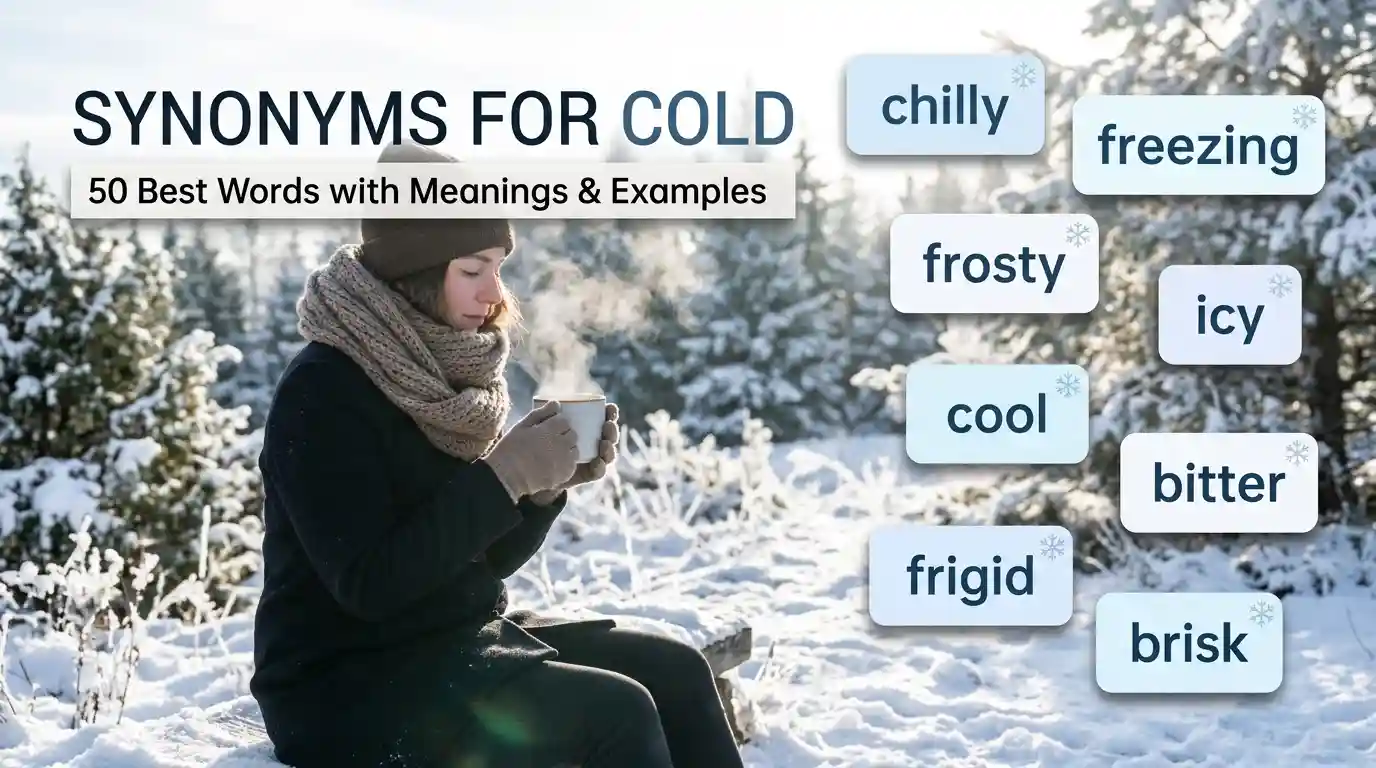
Synonyms for Cold: 50 Best Words with Meanings and Examples
You step outside on a winter morning. Your nose goes numb. You say, “It is cold.” Then you say it again. And again. Sound familiar? Cold means low in temperature. It can also describe a person who shows no warm feelings. It is a small word, but it works very hard. Using the same word too often makes writing dull. That is why synonyms for cold are so helpful. Students can write better essays. Bloggers and content writers can keep readers interested. Daily English users can sound more natural when they speak. In this guide, you will learn 50 fresh synonyms for cold. Each one has a simple meaning and two easy examples. Let’s get started! Chilly Meaning: Chilly means a little cold in a way that feels uncomfortable. Examples: Cool Meaning: Cool means not hot and not very cold. Examples: Freezing Meaning: Freezing means so cold that water can turn into ice. Examples: Frosty Meaning: Frosty means cold enough for thin white ice to cover things. Examples: Icy Meaning: Icy means very cold or covered with ice. Examples: Frigid Meaning: Frigid means extremely cold. Examples: Arctic Meaning: Arctic means very cold, like the far north of the world. Examples: Bitter Meaning: Bitter means sharply and painfully cold. Examples: Biting Meaning: Biting means so cold that it hurts your skin. Examples: Brisk Meaning: Brisk means cool, fresh, and a bit windy. Examples: Crisp Meaning: Crisp means cool and dry in a fresh, pleasant way. Examples: Nippy Meaning: Nippy means slightly cold, enough to make you shiver. Examples: Wintry Meaning: Wintry means cold like winter. Examples: Frozen Meaning: Frozen means turned hard because of very low heat. Examples: Glacial Meaning: Glacial means extremely cold, like thick ice. Examples: Polar Meaning: Polar means very cold, like the North or South Pole. Examples: Raw Meaning: Raw means cold and damp in a way that feels harsh. Examples: Bleak Meaning: Bleak means cold, gray, and not welcoming. Examples: Numbing Meaning: Numbing means so cold that you cannot feel your body. Examples: Gelid Meaning: Gelid means very cold, like ice. Examples: Piercing Meaning: Piercing means so cold that it feels sharp. Examples: Harsh Meaning: Harsh means cold in a strong and unpleasant way. Examples: Stinging Meaning: Stinging means cold that feels like tiny pricks on your skin. Examples: Chilled Meaning: Chilled means made cold on purpose. Examples: Iced Meaning: Iced means cooled with ice. Examples: Shivery Meaning: Shivery means cold enough to make you shake. Examples: Subzero Meaning: Subzero means colder than zero degrees. Examples: Snowy Meaning: Snowy means cold and full of snow. Examples: Draughty Meaning: Draughty means cold because of air coming in through gaps. Examples: Unheated Meaning: Unheated means having no heat to keep it warm. Examples: Bone-Chilling Meaning: Bone-chilling means so cold that you feel it deep inside. Examples: Aloof Meaning: Aloof means cold and not friendly toward others. Examples: Distant Meaning: Distant means not warm or close with people. Examples: Unfriendly Meaning: Unfriendly means not kind or welcoming. Examples: Cold-Hearted Meaning: Cold-hearted means showing no kindness or care. Examples: Stony Meaning: Stony means showing no feeling on the face. Examples: Indifferent Meaning: Indifferent means not caring about something. Examples: Unemotional Meaning: Unemotional means not showing feelings. Examples: Standoffish Meaning: Standoffish means keeping away from other people. Examples: Detached Meaning: Detached means not involved or not showing interest. Examples: Heartless Meaning: Heartless means having no pity for others. Examples: Reserved Meaning: Reserved means quiet and slow to show feelings. Examples: Apathetic Meaning: Apathetic means showing no interest or energy. Examples: Emotionless Meaning: Emotionless means having no feeling in the face or voice. Examples: Unwelcoming Meaning: Unwelcoming means not making people feel happy to be there. Examples: Stiff Meaning: Stiff means cold and formal in how you act. Examples: Cutting Meaning: Cutting means cold in a way that hurts, like a sharp wind or words. Examples: Ice-Cold Meaning: Ice-cold means as cold as ice. Examples: Parky Meaning: Parky is a casual word that means rather cold. Examples: Cheerless Meaning: Cheerless means cold, sad, and without joy. Examples: Conclusion Learning synonyms makes your English richer and more fun. Your writing sounds fresh, your blog posts hold attention, and your speaking becomes clearer. Good word choice also helps people understand your feelings better. Now it is your turn. Pick five new words from this list. Use them in your next email, essay, or chat with a friend. Practice a little each day, and these words will soon feel natural. Keep learning, keep writing, and enjoy the journey! Raheela RaniRaheela Rani is a professional content writer with 3 years of experience in English vocabulary, synonyms, word meanings, and language learning. Through ideamoonhavan.com, she creates clear, accurate, and easy-to-understand content that helps readers expand their vocabulary and use English with confidence.

Synonyms for Focus: 50 Simple Words to Sharpen Your English
Need synonyms for focus? Have you ever read the word “focus” five times in one email? It feels dull, right? Maybe you wrote, “I need to focus on my work, focus on my goals, and focus on my team.” There must be a better way. The word focus means to give all your attention to one thing. That is why synonyms for focus are so helpful. Students use them to make essays stronger. Bloggers and content writers use them to keep readers interested. Daily English users sound more natural and confident. In this guide, you will learn 50 easy synonyms for focus. Each one has a simple meaning and two short examples. Let’s begin! Concentrate Meaning: To think hard about one thing and nothing else. Examples: Attention Meaning: The act of watching or listening with care. Examples: Center Meaning: The most important part of something. Examples: Emphasis Meaning: Special care or weight given to one thing. Examples: Spotlight Meaning: Strong public attention on someone or something. Examples: Zero In Meaning: To move your full attention toward one exact thing. Examples: Target Meaning: To choose one thing as your goal. Examples: Aim Meaning: To try to reach a goal. Examples: Direct Meaning: To point your attention or effort toward something. Examples: Priority Meaning: Something that matters more than other things. Examples: Hub Meaning: The busy center where things come together. Examples: Core Meaning: The most basic and important part. Examples: Heart Meaning: The main or most important part of a thing. Examples: Pinpoint Meaning: To find the exact thing you are looking for. Examples: Concentration Meaning: The power to keep your mind on one thing. Examples: Engage Meaning: To hold someone’s interest or take part fully. Examples: Absorb Meaning: To take in something with your full mind. Examples: Devote Meaning: To give your time or effort to one thing. Examples: Dedicate Meaning: To give yourself fully to a goal. Examples: Fixate Meaning: To stare at or think about one thing too much. Examples: Converge Meaning: To come together at one point. Examples: Narrow Down Meaning: To make a big list smaller. Examples: Home In Meaning: To move closer and closer to one exact point. Examples: Apply Meaning: To use your effort on something. Examples: Immerse Meaning: To be fully inside an activity. Examples: Key Point Meaning: The most important idea in a talk or text. Examples: Highlight Meaning: To make something stand out so people notice it. Examples: Stress Meaning: To say that something is very important. Examples: Prioritize Meaning: To put the most important thing first. Examples: Commit Meaning: To promise your time and effort to something. Examples: Mindfulness Meaning: Paying calm attention to the present moment. Examples: Diligence Meaning: Careful and steady effort in your work. Examples: Attentiveness Meaning: The habit of paying close attention. Examples: Determination Meaning: A strong will to keep going toward a goal. Examples: Clarity Meaning: A clear and sharp way of thinking. Examples: Purpose Meaning: The reason why you do something. Examples: Objective Meaning: A goal you want to reach. Examples: Centerpiece Meaning: The main thing people look at or talk about. Examples: Focal Point Meaning: The spot where attention naturally goes. Examples: Mind Meaning: To pay attention to something with care. Examples: Heed Meaning: To listen to advice and pay attention to it. Examples: Observe Meaning: To watch something closely. Examples: Notice Meaning: To become aware of something by looking. Examples: Study Meaning: To look at something carefully to learn from it. Examples: Train Meaning: To point something at a target, like eyes or a camera. Examples: Sharpen Meaning: To make your mind or skill clearer and stronger. Examples: Fix Meaning: To hold your eyes or mind steady on one thing. Examples: Channel Meaning: To send your energy toward one goal. Examples: Steer Meaning: To guide a talk or action toward one direction. Examples: Single Out Meaning: To pick one thing from a group. Examples: Conclusion Learning synonyms for focus makes you a stronger writer and speaker. With the right words, your blog posts feel fresh, your essays sound smart, and your talks are clear and fun to hear. Good communication starts with the right word at the right time. Now it is your turn. Pick five words from this list today. Use them in an email, an essay, or a chat with a friend. Small practice every day builds big confidence. Keep learning, keep writing, and keep growing! Ibadat FatimaIbadat Fatima is a professional content writer with 3 years of experience in English vocabulary, synonyms, word meanings, and language learning. Through ideamoonhavan.com, she creates clear, accurate, and easy-to-understand content that helps readers expand their vocabulary and communicate in English with confidence.

Synonyms for Fast: 50 Better Words With Meanings and Examples
Imagine you write, “The car was fast. The man was fast. The news was fast.” Does it sound boring? Yes, it does! The good news is that you have many other words to use. Here are some synonyms for fast, like quick, swift, and rapid. Fast means moving or happening at a high speed. It can also mean taking very little time. Students can use these synonyms for fast to write better essays. Bloggers and content writers can use them to keep readers happy. Daily English users can sound more natural and clear. Let’s learn 50 simple words, one by one. Quick Meaning: Quick means done in a short time. Examples: Rapid Meaning: Rapid means happening with great speed. Examples: Swift Meaning: Swift means moving very fast and smoothly. Examples: Speedy Meaning: Speedy means moving or working with high speed. Examples: Hasty Meaning: Hasty means done too fast, often without thinking. Examples: Brisk Meaning: Brisk means quick and full of energy. Examples: Fleet Meaning: Fleet means very fast and light on the feet. Examples: Nimble Meaning: Nimble means quick and light in movement. Examples: Prompt Meaning: Prompt means done right on time or without delay. Examples: Express Meaning: Express means made to be very fast and direct. Examples: Lightning-Fast Meaning: Lightning-fast means extremely fast, like lightning. Examples: Breakneck Meaning: Breakneck means dangerously fast. Examples: Hurried Meaning: Hurried means done in a rush because of little time. Examples: Accelerated Meaning: Accelerated means made faster than normal. Examples: Zippy Meaning: Zippy means fast and full of life. Examples: Snappy Meaning: Snappy means quick and sharp. Examples: Instant Meaning: Instant means happening right away. Examples: Immediate Meaning: Immediate means happening now, with no waiting. Examples: Urgent Meaning: Urgent means needing quick action right now. Examples: High-Speed Meaning: High-speed means moving or working at a very fast rate. Examples: Expeditious Meaning: Expeditious means done fast and with skill. Examples: Whirlwind Meaning: Whirlwind means very fast and busy. Examples: Meteoric Meaning: Meteoric means rising very fast, like a shooting star. Examples: Blistering Meaning: Blistering means extremely fast and strong. Examples: Supersonic Meaning: Supersonic means faster than the speed of sound. Examples: Agile Meaning: Agile means able to move fast and easily. Examples: Lively Meaning: Lively means full of energy and quick movement. Examples: Sprightly Meaning: Sprightly means quick, light, and full of life. Examples: Spry Meaning: Spry means active and quick, even when older. Examples: Fleet-Footed Meaning: Fleet-footed means able to run very fast. Examples: Dashing Meaning: Dashing means moving with quick and bold steps. Examples: Galloping Meaning: Galloping means running very fast, like a horse. Examples: Rushed Meaning: Rushed means done in a hurry. Examples: Sudden Meaning: Sudden means happening fast and without warning. Examples: Flying Meaning: Flying means very fast and short, like a quick visit. Examples: Racing Meaning: Racing means moving very fast, as if in a race. Examples: Efficient Meaning: Efficient means working well and fast without waste. Examples: Fleeting Meaning: Fleeting means passing very quickly. Examples: Momentary Meaning: Momentary means lasting only a very short time. Examples: Cursory Meaning: Cursory means quick and not careful. Examples: Hurtling Meaning: Hurtling means moving very fast, often with force. Examples: Rocketing Meaning: Rocketing means rising very fast. Examples: Fast-Paced Meaning: Fast-paced means moving or changing at a quick speed. Examples: Darting Meaning: Darting means moving quickly in short, sudden moves. Examples: Headlong Meaning: Headlong means going fast and without stopping to think. Examples: Precipitate Meaning: Precipitate means done too fast and too soon. Examples: Abrupt Meaning: Abrupt means sudden and quick, often in a surprising way. Examples: Nippy Meaning: Nippy means quick and light in movement. Examples: Instantaneous Meaning: Instantaneous means happening at the very same moment. Examples: Rapid-Fire Meaning: Rapid-fire means coming one after another very fast. Examples: Conclusion Learning synonyms for fast gives you more power with words. Better words make your writing sharp and lively. Your blog posts keep readers hooked. When you speak, you sound calm and sure, and people follow your ideas with ease. Now it’s time to practice. Pick three new words today. Use them in an email, an essay, or a chat with a friend. Small steps build strong English. Keep going, and enjoy every new word! Ibadat FatimaIbadat Fatima is a professional content writer with 3 years of experience in English vocabulary, synonyms, word meanings, and language learning. Through ideamoonhavan.com, she creates clear, accurate, and easy-to-understand content that helps readers expand their vocabulary and communicate in English with confidence.

Another Word for Establishing: 30 Synonyms With Examples
The most common everyday alternatives to “establishing” are setting up, founding, starting, and creating. If you mean proving something, use proving or confirming. If you mean making something firm and lasting, try solidifying or securing. “Establishing” is the -ing form of the verb establish, so every alternative here is also given in its -ing form. The best choice depends on meaning and context. You can establish a company (founding), a rule (instituting), a fact (proving), a relationship (building), or a reputation (earning). Each sense needs a different word, and a good synonym in one sentence can sound odd in another. Quick list: setting up, founding, starting, creating, forming, building, instituting, proving, confirming, securing This article looks at 30 alternatives. Each has a meaning, IPA pronunciation, a usage note, and an example, and the words are grouped by context. At a Glance: Establishing Synonyms and Related Alternatives Alternative Part of Speech Meaning Register / Tone Ideal Context Setting up Verb / gerund Arranging something so it can begin to work Neutral, everyday Businesses, accounts, systems Founding Verb / gerund Starting an organization or institution Neutral to formal Companies, schools, nations Starting Verb / gerund Beginning something new Casual, common General use Instituting Verb / gerund Introducing an official rule, system, or practice Formal Policies, laws, programs Proving Verb / gerund Showing that something is true Neutral Facts, claims, theories Confirming Verb / gerund Making something certain with evidence Neutral Facts, plans, identity Solidifying Verb / gerund Making something firm and secure Neutral, figurative Positions, relationships Enacting Verb / gerund Making a law official Formal, legal Laws, legislation Settling Verb / gerund Taking a stable place or position Neutral Living, working, routines Earning Verb / gerund Gaining something through effort Neutral Reputation, trust, respect Which Word Should You Use? If you want to… Use Why Talk about starting a company or school Founding It suggests creating something lasting from the beginning. Use a simple, everyday word Setting up It works for businesses, accounts, meetings, and systems. Talk about an official rule or policy Instituting It sounds formal and suits organizations and governments. Talk about making a law Enacting It is the standard word for making a law official. Say you are showing a fact is true Proving It is direct and clear. Say you are checking that something is correct Verifying It means testing accuracy rather than starting something. Talk about gaining a good name Earning It shows that the reputation came from effort. Talk about making a position stronger Solidifying It means making something already present more firm. Exploring the Multiple Meanings of “Establishing” 1. Setting Up an Organization or System 2. Making Something Firm or Lasting 3. Proving or Showing Something Is True 4. Creating a Relationship, Rule, or Connection 5. Gaining a Secure Position or Reputation 6. Describing a Film Shot (Establishing Shot) Sources: Merriam-Webster, Collins Dictionary, Dictionary.com (entries for “establish”) Analyzing 30 Establishing Alternatives in Detail Some of these words are close synonyms of “establishing,” while others fit only one sense or context, and each usage note says which. Group 1: Core Alternatives for Setting Up 1. Setting up IPA: /ˈsetɪŋ ʌp/ (US and UK) Definition: Arranging or preparing something so it is ready to operate. 2. Starting IPA: US /ˈstɑːrtɪŋ/ · UK /ˈstɑːtɪŋ/ Definition: Beginning to do or make something. 3. Creating IPA: /kriˈeɪtɪŋ/ (US and UK) Definition: Bringing something into existence. 4. Founding IPA: /ˈfaʊndɪŋ/ (US and UK) Definition: Starting an organization, institution, or town, often with funds or a plan to last. 5. Forming IPA: US /ˈfɔːrmɪŋ/ · UK /ˈfɔːmɪŋ/ Definition: Bringing something into being by joining parts or developing it over time. 6. Building IPA: /ˈbɪldɪŋ/ (US and UK) Definition: Developing something step by step over time. Group 2: Formal and Institutional Alternatives 7. Instituting IPA: US /ˈɪnstɪtuːtɪŋ/ · UK /ˈɪnstɪtjuːtɪŋ/ Definition: Introducing and starting an official system, rule, or practice. 8. Inaugurating IPA: US /ɪˈnɔːɡjəreɪtɪŋ/ · UK /ɪˈnɔːɡjʊreɪtɪŋ/ Definition: Formally starting something, or officially placing a person in office. 9. Launching IPA: /ˈlɔːntʃɪŋ/ (US and UK) Definition: Starting something new, especially a product, project, or campaign. 10. Organizing IPA: US /ˈɔːrɡənaɪzɪŋ/ · UK /ˈɔːɡənaɪzɪŋ/ Definition: Arranging parts so that something works in an orderly way. 11. Installing IPA: /ɪnˈstɔːlɪŋ/ (US and UK) Definition: Placing a person in an office or position, or fitting equipment into place. Group 3: Proving and Confirming Alternatives 12. Proving IPA: /ˈpruːvɪŋ/ (US and UK) Definition: Showing by evidence that something is true. 13. Demonstrating IPA: /ˈdemənstreɪtɪŋ/ (US and UK) Definition: Showing clearly that something is true or how it works. 14. Verifying IPA: /ˈverɪfaɪɪŋ/ (US and UK) Definition: Checking that something is true or correct. 15. Confirming IPA: US /kənˈfɜːrmɪŋ/ · UK /kənˈfɜːmɪŋ/ Definition: Making something certain by giving proof or approval. 16. Substantiating IPA: /səbˈstænʃieɪtɪŋ/ (US and UK) Definition: Supporting a claim with evidence. Group 4: Making Firm and Stable 17. Securing IPA: US /sɪˈkjʊrɪŋ/ · UK /sɪˈkjʊərɪŋ/ Definition: Making something safe, firm, or certain. 18. Strengthening IPA: /ˈstreŋkθənɪŋ/ (US and UK) Definition: Making something stronger. 19. Solidifying IPA: /səˈlɪdɪfaɪɪŋ/ (US and UK) Definition: Making something firm, fixed, or more certain. 20. Cementing IPA: /sɪˈmentɪŋ/ (US and UK) Definition: Making a relationship, position, or agreement firm and lasting. 21. Entrenching IPA: /ɪnˈtrentʃɪŋ/ (US and UK) Definition: Fixing something so firmly that it is hard to change. Group 5: Rules, Contact, and Arrangements 22. Setting IPA: /ˈsetɪŋ/ (US and UK) Definition: Deciding or fixing something such as a rule, price, or limit. 23. Enacting IPA: /ɪˈnæktɪŋ/ (US and UK) Definition: Making a bill into an official law. 24. Arranging IPA: /əˈreɪndʒɪŋ/ (US and UK) Definition: Planning or organizing something so it can happen. 25. Initiating IPA: /ɪˈnɪʃieɪtɪŋ/ (US and UK) Definition: Causing something to begin. 26. Opening IPA: US /ˈoʊpənɪŋ/ · UK /ˈəʊpənɪŋ/ Definition: Starting a new line of communication, business, or process. Group 6: Gaining Position and Recognition 27. Settling IPA: /ˈsetlɪŋ/ (US and UK) Definition: Making a home, job, or routine in a place and
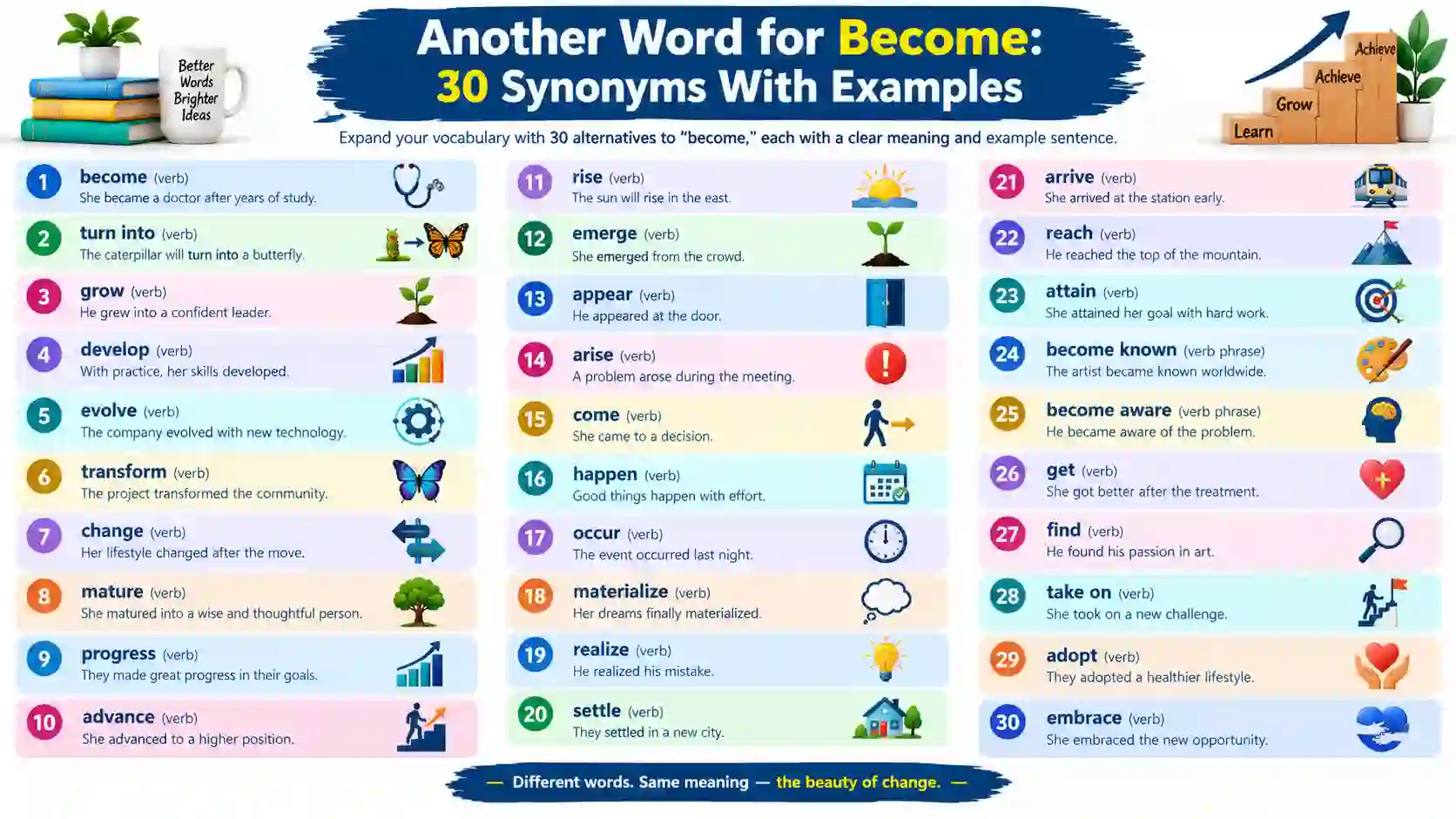
Another Word for Become: 30 Synonyms With Examples
The closest everyday alternatives to become are get, grow, turn, and turn into. For example, “It became cold” can be “It got cold” or “It turned cold.” If someone changes into a new role or form, you can say turn into, change into, or grow into. The best choice depends on the meaning and the context. “Become” covers several ideas: reaching a new state (get, go, fall), changing into something else (transform, convert), growing slowly (develop, mature, evolve), and, less often, suiting someone (suit, befit, flatter). Some of these words are exact matches for one meaning and only loose matches for another, so the choice matters. Quick list: get, grow, turn, turn into, change, transform, develop, evolve, end up, suit This article looks at 30 alternatives to “become.” Each one comes with its meaning, IPA, a usage note, and an example, so you can see which fit which context. At a Glance: Become Synonyms and Related Alternatives Alternative Part of Speech Meaning Register / Tone Ideal Context Get Verb Reach a state Informal, neutral Everyday speech: get tired, get dark Grow Verb Slowly come to be Neutral to literary Gradual feelings or conditions Turn Verb Change, often suddenly Neutral Weather, color, mood Go Verb Pass into a state Informal Unwanted states: go bad, go quiet Turn into Phrasal verb Change into something else Neutral Noun results: turn into a star Transform Verb Change completely Neutral to formal Big, striking changes Develop Verb Grow into a fuller state Neutral Ideas, towns, skills, illness End up Phrasal verb Reach a final state Informal Unplanned outcomes Emerge Verb Come out or become known Formal Leaders, trends, facts Suit Verb Look good on Neutral Clothes, hair, colors Which Word Should You Use? If you want to… Use Why Say a state changed in casual speech get It is the most common informal choice with adjectives. Show a slow change grow It suggests gradual change: grow tired, grow louder. Show a sudden or complete change turn It fits weather, color, and mood. Say one thing changed into another thing turn into It works naturally with nouns. Describe a dramatic change in form transform It signals a big, deep change. Describe a slow, step-by-step change evolve It suggests a gradual move to something more complex. Say a result was unplanned end up It focuses on the final outcome. Say clothes look good on someone suit It matches that sense of “become” exactly. Exploring the Multiple Meanings of “Become” 1. To Come to Be a State or Condition 2. To Grow or Change into Something or Someone 3. To Suit or Look Good On 4. To Be Right or Proper For 5. To Happen To (become of) Sources: Merriam-Webster; Collins English Dictionary; Cambridge Dictionary. Analyzing 30 Become Alternatives in Detail Some alternatives are direct synonyms of “become,” while others fit only one meaning or one context, and the notes say which. Everyday State-Change Words 1. Get IPA: /ɡɛt/ (US and UK) Definition: To reach a particular state or condition. 2. Grow IPA: US /ɡroʊ/ · UK /ɡrəʊ/ Definition: To gradually come to be in a certain state. 3. Turn IPA: US /tɝːn/ · UK /tɜːn/ Definition: To change to a different state, color, or quality. 4. Go IPA: US /ɡoʊ/ · UK /ɡəʊ/ Definition: To pass into a particular state, often a bad or unwanted one. 5. Come IPA: /kʌm/ (US and UK) Definition: To reach a certain state or condition. Changing Into Something Else 6. Turn into IPA: US /tɝːn ˈɪntuː/ · UK /tɜːn ˈɪntuː/ Definition: To change into a different thing or form. 7. Change IPA: /tʃeɪndʒ/ (US and UK) Definition: To become different, or to make something different. 8. Transform IPA: US /trænsˈfɔːrm/ · UK /trænsˈfɔːm/ Definition: To change completely in form, appearance, or nature. 9. Convert IPA: US /kənˈvɝːt/ · UK /kənˈvɜːt/ Definition: To change from one form, use, or system to another. 10. Morph IPA: US /mɔːrf/ · UK /mɔːf/ Definition: To change smoothly from one form into another. Gradual Growth and Development 11. Grow into IPA: US /ɡroʊ ˈɪntuː/ · UK /ɡrəʊ ˈɪntuː/ Definition: To gradually become a particular kind of person or thing. 12. Develop IPA: /dɪˈveləp/ (US and UK) Definition: To grow or change into a fuller, more advanced, or more complete state. 13. Evolve IPA: US /ɪˈvɑːlv/ · UK /ɪˈvɒlv/ Definition: To change or develop gradually, often into a more complex form. 14. Mature IPA: US /məˈtʃʊr/ · UK /məˈtʃʊə/ Definition: To become fully grown or developed. 15. Ripen IPA: /ˈraɪpən/ (US and UK) Definition: To become ripe, or ready to eat or use. 16. Blossom IPA: US /ˈblɑːsəm/ · UK /ˈblɒsəm/ Definition: To develop in a successful or promising way. Outcome and Role Alternatives 17. End up IPA: /ɛnd ˈʌp/ (US and UK) Definition: To reach a final state, place, or situation, often without planning it. 18. Wind up IPA: /waɪnd ˈʌp/ (US and UK) Definition: To reach a final place or condition after a series of events. 19. Turn out IPA: US /tɝːn ˈaʊt/ · UK /tɜːn ˈaʊt/ Definition: To prove to be a certain way after events have developed. 20. Emerge IPA: US /ɪˈmɝːdʒ/ · UK /ɪˈmɜːdʒ/ Definition: To come out of something, or to become known or noticed. 21. Assume IPA: US /əˈsuːm/ · UK /əˈsjuːm/ Definition: To take on a role, quality, or appearance. 22. Come to be IPA: US /kʌm tə ˈbiː/ · UK /kʌm tə ˈbiː/ Definition: To gradually reach a certain state or position. Fixed-Use and Literary Alternatives 23. Fall IPA: /fɔːl/ (US and UK) Definition: To pass into a state, usually suddenly and often an unwanted one. 24. Wax IPA: /wæks/ (US and UK) Definition: To become or grow, especially in set phrases. 25. Metamorphose IPA: US /ˌmɛtəˈmɔːrfoʊz/ · UK /ˌmetəˈmɔːfəʊz/ Definition: To change completely in form, especially in a natural process. Alternatives for the “Suit” Meaning 26. Suit IPA: /suːt/ (US and UK) Definition: To look good on someone, or to be right for them. 27. Flatter
Another Word for Urgent: 30 Synonyms With Examples
Another word for urgent is pressing. Other common alternatives are critical, immediate, imperative, and crucial. Each one fits a slightly different situation. Urgent usually means something needs action now, but it can also describe a serious need, a short deadline, or an insistent tone of voice. The best choice depends on which meaning you want. Pressing suits a problem that cannot wait, critical suits high stakes, and imperative suits a duty or a must-do task. Insistent suits a request pushed with force. Quick list: pressing, critical, imperative, immediate, crucial, vital, exigent, acute, dire, insistent This article looks at 30 alternatives, with meanings, IPA, usage notes, examples, and context. It also covers opposites, word partners, expressions, word history, and common mistakes. At a Glance: Urgent Synonyms and Related Alternatives Alternative Part of Speech Meaning Register / Tone Ideal Context Pressing adjective needing attention now neutral problems, needs, tasks Critical adjective extremely important to the outcome neutral to formal medical, business, safety Imperative adjective absolutely necessary formal duties, policies, strategy Immediate adjective happening or needed without delay neutral action, response, help Crucial adjective very important to success or failure neutral decisions, steps, factors Vital adjective essential, with serious results if ignored neutral health, resources, information Exigent adjective demanding immediate action formal, rare legal, official, literary writing Acute adjective severe and needing quick attention formal, technical shortages, crises, medicine Dire adjective extremely serious or desperate strong, dramatic crises, warnings, shortages Insistent adjective demanding attention with force neutral requests, voices, messages Which Word Should You Use? If you want to… Use Why Describe a problem that cannot wait pressing It is natural and common in speech and writing. Stress that failure would be serious critical It focuses on stakes, not just timing. Say something is a must-do duty imperative It suggests necessity, often in formal writing. Ask for action with no delay immediate It points to time: right now. Write in a formal or legal style exigent It is rare and fits official or literary writing. Describe a desperate shortage or crisis dire It adds fear and seriousness. Describe a forceful request or voice insistent It focuses on how strongly someone is asking. Mark a deadline-driven task rush It is informal and fits work settings. Exploring the Multiple Meanings of “Urgent” 1. Needing Action Right Away 2. Important and Time-Limited 3. Serious or Critical Need 4. Insistent or Pressing in Manner 5. Prompt but Not Life-Threatening (Medical Use) Sources: Merriam-Webster, Collins English Dictionary, and Dictionary.com (entries for “urgent”). Analyzing 30 Urgent Alternatives in Detail Some of these words are direct synonyms of urgent, while others are related alternatives that fit only certain contexts. The notes say which is which. Core Synonyms 1. Pressing IPA: /ˈprɛsɪŋ/ (US and UK) Definition: Demanding immediate attention. 2. Critical IPA: /ˈkrɪtɪkəl/ (US and UK) Definition: Extremely important because the outcome depends on it. 3. Imperative IPA: /ɪmˈpɛrətɪv/ (US and UK) Definition: Absolutely necessary; that must be done. 4. Immediate IPA: /ɪˈmiːdiət/ (US and UK) Definition: Happening or done at once, without delay. 5. Crucial IPA: /ˈkruːʃəl/ (US and UK) Definition: Extremely important, especially for success or failure. 6. Vital IPA: /ˈvaɪtəl/ (US and UK) Definition: Necessary to life, success, or the continued existence of something. Formal and Serious Alternatives 7. Exigent IPA: /ˈɛksɪdʒənt/ (US and UK) Definition: Requiring immediate action or attention. 8. Acute IPA: /əˈkjuːt/ (US and UK) Definition: Severe and sharp, often needing quick attention. 9. Grave IPA: /ɡreɪv/ (US and UK) Definition: Very serious and important. 10. Imminent IPA: /ˈɪmɪnənt/ (US and UK) Definition: About to happen very soon. Time and Speed Alternatives 11. Prompt IPA: US /prɑːmpt/ · UK /prɒmpt/ Definition: Done quickly and without delay. 12. Rush IPA: /rʌʃ/ (US and UK) Definition: Done or needed in great haste. 13. Instant IPA: /ˈɪnstənt/ (US and UK) Definition: Happening at once. 14. Swift IPA: /swɪft/ (US and UK) Definition: Happening quickly or promptly. 15. Express IPA: /ɪkˈsprɛs/ (US and UK) Definition: Fast and direct, often meant for quick delivery. Priority and Importance Alternatives 16. Paramount IPA: /ˈpærəmaʊnt/ (US and UK) Definition: More important than anything else. 17. Essential IPA: /ɪˈsɛnʃəl/ (US and UK) Definition: Absolutely necessary. 18. Burning IPA: US /ˈbɜːrnɪŋ/ · UK /ˈbɜːnɪŋ/ Definition: Strongly felt and of great current interest or concern. 19. Necessary IPA: US /ˈnɛsəˌsɛri/ · UK /ˈnesəsəri/ Definition: Needed to achieve a result. 20. Overriding IPA: US /ˌoʊvərˈraɪdɪŋ/ · UK /ˌəʊvəˈraɪdɪŋ/ Definition: More important than all other considerations. Emergency and Crisis Alternatives 21. Dire IPA: US /daɪr/ · UK /ˈdaɪə/ Definition: Extremely serious or bad. 22. Desperate IPA: /ˈdɛspərət/ (US and UK) Definition: Having an extreme need, with little hope of other solutions. 23. Emergency IPA: US /ɪˈmɜːrdʒənsi/ · UK /ɪˈmɜːdʒənsi/ Definition: A sudden, serious situation needing immediate action. As an adjective before a noun, it means used or done in such a situation. 24. Frantic IPA: /ˈfræntɪk/ (US and UK) Definition: Done in a wild, rushed, or fearful way. 25. Serious IPA: US /ˈsɪriəs/ · UK /ˈsɪəriəs/ Definition: Important and having possible bad results. Insistent and Forceful Alternatives 26. Insistent IPA: /ɪnˈsɪstənt/ (US and UK) Definition: Demanding something firmly and refusing to be ignored. 27. Importunate IPA: US /ɪmˈpɔːrtʃənət/ · UK /ɪmˈpɔːtʃənət/ Definition: Persistent in asking for something, often in an annoying way. 28. Compelling IPA: /kəmˈpɛlɪŋ/ (US and UK) Definition: Strongly demanding attention or action. 29. Demanding IPA: US /dɪˈmændɪŋ/ · UK /dɪˈmɑːndɪŋ/ Definition: Requiring a lot of time, effort, or attention. 30. Earnest IPA: US /ˈɜːrnɪst/ · UK /ˈɜːnɪst/ Definition: Serious and sincere. Sources: Merriam-Webster, Collins English Dictionary and Thesaurus, and Dictionary.com (entries for the words above). Urgent vs. Important vs. Emergency vs. Critical These words are often mixed up, especially in work and health settings. Word Main Idea Time Pressure Example Urgent Needs action soon High An urgent email about tomorrow’s meeting Important Has high value or effect Not always Important long-term planning Critical Stakes are very high Often high Critical medical care Emergency Sudden danger needing action now Very high A fire or a