
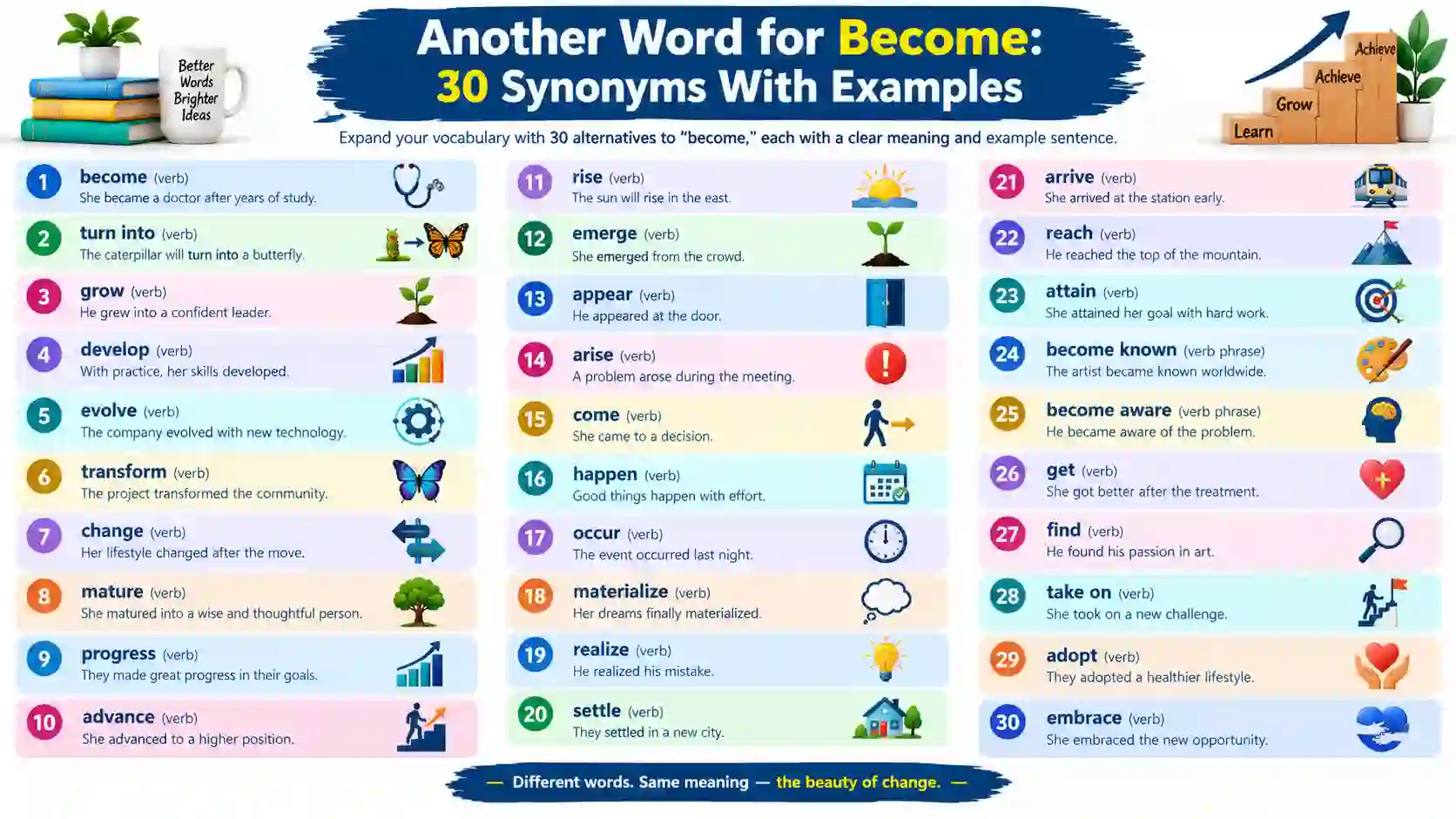
The closest everyday alternatives to become are get, grow, turn, and turn into. For example, “It became cold” can be “It got cold” or “It turned cold.” If someone changes into a new role or form, you can say turn into, change into, or grow into. The best choice depends on the meaning and the context.
“Become” covers several ideas: reaching a new state (get, go, fall), changing into something else (transform, convert), growing slowly (develop, mature, evolve), and, less often, suiting someone (suit, befit, flatter). Some of these words are exact matches for one meaning and only loose matches for another, so the choice matters.
Quick list: get, grow, turn, turn into, change, transform, develop, evolve, end up, suit
This article looks at 30 alternatives to “become.” Each one comes with its meaning, IPA, a usage note, and an example, so you can see which fit which context.
At a Glance: Become Synonyms and Related Alternatives
| Alternative | Part of Speech | Meaning | Register / Tone | Ideal Context |
| Get | Verb | Reach a state | Informal, neutral | Everyday speech: get tired, get dark |
| Grow | Verb | Slowly come to be | Neutral to literary | Gradual feelings or conditions |
| Turn | Verb | Change, often suddenly | Neutral | Weather, color, mood |
| Go | Verb | Pass into a state | Informal | Unwanted states: go bad, go quiet |
| Turn into | Phrasal verb | Change into something else | Neutral | Noun results: turn into a star |
| Transform | Verb | Change completely | Neutral to formal | Big, striking changes |
| Develop | Verb | Grow into a fuller state | Neutral | Ideas, towns, skills, illness |
| End up | Phrasal verb | Reach a final state | Informal | Unplanned outcomes |
| Emerge | Verb | Come out or become known | Formal | Leaders, trends, facts |
| Suit | Verb | Look good on | Neutral | Clothes, hair, colors |
Which Word Should You Use?
| If you want to… | Use | Why |
| Say a state changed in casual speech | get | It is the most common informal choice with adjectives. |
| Show a slow change | grow | It suggests gradual change: grow tired, grow louder. |
| Show a sudden or complete change | turn | It fits weather, color, and mood. |
| Say one thing changed into another thing | turn into | It works naturally with nouns. |
| Describe a dramatic change in form | transform | It signals a big, deep change. |
| Describe a slow, step-by-step change | evolve | It suggests a gradual move to something more complex. |
| Say a result was unplanned | end up | It focuses on the final outcome. |
| Say clothes look good on someone | suit | It matches that sense of “become” exactly. |
Exploring the Multiple Meanings of “Become”
1. To Come to Be a State or Condition
- Meaning: To pass into a state or condition.
- Explanation: This is the most common use. It follows an adjective and shows a change from one condition to another. Here, “become” is the most neutral of the options.
- Example: The sky became dark before the storm arrived.
2. To Grow or Change into Something or Someone
- Meaning: To turn into a new thing, role, or type of person.
- Explanation: Here “become” is followed by a noun. It can describe a job, a role, a change of identity, or a new form.
- Example: She became a doctor after ten years of study.
3. To Suit or Look Good On
- Meaning: To look attractive on someone.
- Explanation: This sense is older and now mostly formal or old-fashioned. The thing that looks good is the subject, and the person is the object.
- Example: That shade of green becomes you.
4. To Be Right or Proper For
- Meaning: To be suitable for a person or situation.
- Explanation: This sense is formal and often appears in negative phrasing. It is about behavior that fits (or does not fit) a person’s position.
- Example: Such rude behavior hardly becomes a teacher.
5. To Happen To (become of)
- Meaning: To happen to someone or something.
- Explanation: This sense appears only in the pattern “become of,” usually in questions about a person or thing that is no longer seen or known.
- Example: Nobody knows what became of the old house.
Sources: Merriam-Webster; Collins English Dictionary; Cambridge Dictionary.
Analyzing 30 Become Alternatives in Detail
Some alternatives are direct synonyms of “become,” while others fit only one meaning or one context, and the notes say which.
Everyday State-Change Words
1. Get
IPA: /ɡɛt/ (US and UK)
Definition: To reach a particular state or condition.
- Usage: The most common informal alternative to “become” with adjectives. It does not normally take a noun, so “get a doctor” does not mean “become a doctor.”
- Example: It gets dark early in winter.
2. Grow
IPA: US /ɡroʊ/ · UK /ɡrəʊ/
Definition: To gradually come to be in a certain state.
- Usage: A direct synonym when the change is slow. It is common with adjectives such as old, tired, quiet, and loud, and sounds a little more careful or literary than “get.”
- Example: The music grew louder as the band came closer.
3. Turn
IPA: US /tɝːn/ · UK /tɜːn/
Definition: To change to a different state, color, or quality.
- Usage: A direct synonym for sudden or complete change. It is common with weather, color, age, and mood.
- Example: The weather turned cold overnight.
4. Go
IPA: US /ɡoʊ/ · UK /ɡəʊ/
Definition: To pass into a particular state, often a bad or unwanted one.
- Usage: Informal. It appears in fixed patterns such as go bad, go blind, go quiet, and go wrong. It is not a free replacement for “become.”
- Example: The milk went sour in the heat.
5. Come
IPA: /kʌm/ (US and UK)
Definition: To reach a certain state or condition.
- Usage: A related alternative that works only in fixed phrases, such as come true, come loose, and come undone.
- Example: Her dream finally came true.
Changing Into Something Else
6. Turn into
IPA: US /tɝːn ˈɪntuː/ · UK /tɜːn ˈɪntuː/
Definition: To change into a different thing or form.
- Usage: One of the closest everyday matches when “become” is followed by a noun. It is neutral and works for both literal and figurative change.
- Example: The small shop turned into a large business.
7. Change
IPA: /tʃeɪndʒ/ (US and UK)
Definition: To become different, or to make something different.
- Usage: A broad, neutral alternative. It usually needs “into” before a noun, as in “change into a frog.” It is less specific than “become,” because it does not name the new state.
- Example: The tadpole changed into a frog.
8. Transform
IPA: US /trænsˈfɔːrm/ · UK /trænsˈfɔːm/
Definition: To change completely in form, appearance, or nature.
- Usage: Stronger than “become” and suggests a deep, striking change. It is usually transitive, so “transform into” is less common than “was transformed into.”
- Example: The empty lot was transformed into a garden.
9. Convert
IPA: US /kənˈvɝːt/ · UK /kənˈvɜːt/
Definition: To change from one form, use, or system to another.
- Usage: A related alternative, not a general synonym. It suggests a planned or practical change, and it is often passive.
- Example: The old factory was converted into apartments.
10. Morph
IPA: US /mɔːrf/ · UK /mɔːf/
Definition: To change smoothly from one form into another.
- Usage: Informal and often used for gradual change into something unexpected. It also has a technical meaning in computer graphics.
- Example: The small project slowly morphed into a full company.
Gradual Growth and Development
11. Grow into
IPA: US /ɡroʊ ˈɪntuː/ · UK /ɡrəʊ ˈɪntuː/
Definition: To gradually become a particular kind of person or thing.
- Usage: A close match for “become” when change happens over time, such as with age or experience. It often carries a positive tone.
- Example: She grew into a confident leader.
12. Develop
IPA: /dɪˈveləp/ (US and UK)
Definition: To grow or change into a fuller, more advanced, or more complete state.
- Usage: A related alternative, usually in the pattern “develop into.” It does not work with simple adjectives, so “develop tired” is wrong.
- Example: The small town developed into a busy port.
13. Evolve
IPA: US /ɪˈvɑːlv/ · UK /ɪˈvɒlv/
Definition: To change or develop gradually, often into a more complex form.
- Usage: A related alternative for slow, long-term change in ideas, systems, or living things. It is not used for sudden change.
- Example: The company evolved from a small shop into a global brand.
14. Mature
IPA: US /məˈtʃʊr/ · UK /məˈtʃʊə/
Definition: To become fully grown or developed.
- Usage: A related alternative that works only for growth toward fullness, such as a person, a plan, or a wine.
- Example: He matured a lot during his years abroad.
15. Ripen
IPA: /ˈraɪpən/ (US and UK)
Definition: To become ripe, or ready to eat or use.
- Usage: A narrow related alternative. It fits fruit, and sometimes plans or feelings that are fully developed.
- Example: The tomatoes will ripen in the sun.
16. Blossom
IPA: US /ˈblɑːsəm/ · UK /ˈblɒsəm/
Definition: To develop in a successful or promising way.
- Usage: A related alternative with a positive tone. It is literal for flowers and figurative for people, talent, or relationships.
- Example: Their friendship blossomed into love.
Outcome and Role Alternatives
17. End up
IPA: /ɛnd ˈʌp/ (US and UK)
Definition: To reach a final state, place, or situation, often without planning it.
- Usage: A close informal match when the result is unplanned or surprising. It is often followed by “as,” “in,” or an “-ing” form.
- Example: He ended up a teacher, though he had planned to be a pilot.
18. Wind up
IPA: /waɪnd ˈʌp/ (US and UK)
Definition: To reach a final place or condition after a series of events.
- Usage: Very informal and close to “end up.”
- Example: We wound up in a tiny town with no hotel.
19. Turn out
IPA: US /tɝːn ˈaʊt/ · UK /tɜːn ˈaʊt/
Definition: To prove to be a certain way after events have developed.
- Usage: A related alternative. It most often appears as “turn out to be,” and it focuses on discovering what something is rather than on the change itself.
- Example: The quiet man turned out to be a famous author.
20. Emerge
IPA: US /ɪˈmɝːdʒ/ · UK /ɪˈmɜːdʒ/
Definition: To come out of something, or to become known or noticed.
- Usage: A formal related alternative. In “emerge as,” it means to become clearly seen as something.
- Example: She emerged as the leading candidate.
21. Assume
IPA: US /əˈsuːm/ · UK /əˈsjuːm/
Definition: To take on a role, quality, or appearance.
- Usage: A formal related alternative. It describes taking on something rather than naturally changing into it.
- Example: He assumed the role of team leader.
22. Come to be
IPA: US /kʌm tə ˈbiː/ · UK /kʌm tə ˈbiː/
Definition: To gradually reach a certain state or position.
- Usage: A direct synonym phrase that is slightly formal. It is often used with “known as.”
- Example: She came to be known as the town’s best baker.
Fixed-Use and Literary Alternatives
23. Fall
IPA: /fɔːl/ (US and UK)
Definition: To pass into a state, usually suddenly and often an unwanted one.
- Usage: A related alternative used only in fixed phrases: fall ill, fall asleep, fall silent, fall in love.
- Example: He fell ill just before the trip.
24. Wax
IPA: /wæks/ (US and UK)
Definition: To become or grow, especially in set phrases.
- Usage: A literary related alternative used with only a few words, as in “wax lyrical.” It also describes the moon growing larger.
- Example: He waxed lyrical about his trip to Italy.
25. Metamorphose
IPA: US /ˌmɛtəˈmɔːrfoʊz/ · UK /ˌmetəˈmɔːfəʊz/
Definition: To change completely in form, especially in a natural process.
- Usage: A formal or scientific related alternative. It is used literally for insects and frogs and figuratively for large changes.
- Example: The caterpillar metamorphoses into a butterfly.
Alternatives for the “Suit” Meaning
26. Suit
IPA: /suːt/ (US and UK)
Definition: To look good on someone, or to be right for them.
- Usage: The closest everyday match for the “look good on” sense of “become.” It does not match the “change into” sense.
- Example: Short hair really suits her.
27. Flatter
IPA: US /ˈflætɚ/ · UK /ˈflætə/
Definition: To make someone look more attractive.
- Usage: A related alternative that stresses showing off someone’s best features.
- Example: That color flatters you.
28. Befit
IPA: /bɪˈfɪt/ (US and UK)
Definition: To be right or proper for a person or occasion.
- Usage: A formal alternative for the “be proper for” sense. The thing that is proper is the subject.
- Example: A quiet ceremony befits the occasion.
29. Look good on
IPA: US /lʊk ɡʊd ɑːn/ · UK /lʊk ɡʊd ɒn/
Definition: To make a person look attractive when worn or used.
- Usage: The most natural informal replacement for the clothing sense of “become.”
- Example: That blue coat looks good on you.
30. Complement
IPA: US /ˈkɑːmplɪment/ · UK /ˈkɒmplɪment/
Definition: To go well with something and make it better.
- Usage: A loose related alternative, not a true synonym. It is about two things working well together rather than one thing flattering a person.
- Example: The scarf complements her jacket.
Sources: Merriam-Webster; Collins English Dictionary; Cambridge Dictionary; Dictionary.com.
Become vs. Get vs. Grow vs. Turn vs. Go
These five words often fill the same slot, but they sound different in different situations.
| Word | Typical Feel | Typical Partners | Example |
| become | Neutral; works with adjectives and nouns | clear, famous, a teacher | He became famous. |
| get | Informal, everyday | tired, lost, dark | I got tired. |
| grow | Slow, gradual | old, quiet, used to | She grew tired of waiting. |
| turn | Sudden or complete | cold, red, sour | The leaves turned red. |
| go | Often unwanted | bad, wrong, blind | The plan went wrong. |
“Become” is the safest all-purpose word, and it is the only one in this group that works easily with nouns of identity: “He became a teacher.” The others often depend on fixed pairings, so check the pattern before swapping.
Sources: Merriam-Webster; Collins English Dictionary; Cambridge Dictionary.
Become and Opposite/Paired Word Pairs
| Word | Paired Word | Note |
| become | remain | “Become” shows change; “remain” shows no change. |
| become | stay | A common informal opposite: stay calm vs. become calm. |
| become | cease to be | A formal contrast: stop being something. |
| becoming | unbecoming | Adjectives: attractive or proper vs. unattractive or improper. |
| suit | clash with | Colors or styles that look good together vs. badly together. |
“Become” describes change, so its best opposites describe the lack of change (remain, stay). The pair “becoming” and “unbecoming” comes from the adjective sense and is separate from the verb pair.
Sources: Merriam-Webster; Collins English Dictionary; Cambridge Dictionary.
Common Word Partners of “Become”
| Pattern | Common Partners | Example |
| become + adjective | clear, aware, popular, difficult | It became clear that she was right. |
| become + noun | a doctor, a member, a parent, a reality | He became a member of the club. |
| become + increasingly / more | increasingly difficult, more common | Travel became increasingly expensive. |
| become + past participle | known, available, involved | The report became available online. |
| become + law / reality | law, reality | The bill became law last year. |
| become + habit / part | a habit, part of | Daily walking became part of her routine. |
| become of | what became of | What became of your old friend? |
Sources: Collins English Dictionary; Merriam-Webster; Cambridge Dictionary.
Idiomatic Phrases Featuring “Become”
These are established expressions. Some are true idioms, and others are fixed or formal patterns.
1. What became of…?
- Meaning: What happened to someone or something that is no longer known or seen.
- Example: Whatever became of the boy who lived next door?
2. Become second nature
- Meaning: To become so familiar that you do it without thinking.
- Example: After a year of practice, driving became second nature.
3. Ill becomes you
- Meaning: It does not suit or fit you to behave in this way. This is a formal expression.
- Example: It ill becomes you to complain after all the help you received.
4. Become a household name
- Meaning: To become very well known.
- Example: The small bakery became a household name in the city.
Sources: Merriam-Webster; Cambridge Dictionary; Collins English Dictionary.
Word Formation of “Become”
Etymology & Structure
“Become” is made from the prefix be- and the verb come. It comes from the Old English becuman, which meant “to come to, arrive, happen.” The prefix be- here works as an intensifier or a marker of direction. Related forms exist in other Germanic languages, such as German bekommen (“to get, receive”).
Date and History
The word goes back to Old English, before about 1150. The sense of changing into a state developed later, in Middle English. The “suit” meaning also developed over time from the idea of something coming to or fitting a person.
Word Class Variations
- Verb: become, becomes, became, becoming (past participle: become)
- Adjective: becoming (attractive or suitable), unbecoming
- Adverb: becomingly
- Noun: becoming (the process of coming to be, mostly in philosophy), becomingness (rare)
Sources: Etymonline; Merriam-Webster; Collins English Dictionary.
Common Word-Choice Mistakes
- He became to be a doctor: He became a doctor.
- What happened of the old school?: What became of the old school?
- She got a famous singer: She became a famous singer.
- The caterpillar converted into a butterfly: The caterpillar turned into (or changed into) a butterfly.
- The color become you: The color becomes you.
- She befits the role: The role befits her.
- He ended up to be a teacher: He ended up as a teacher (or ended up being a teacher).
Frequently Asked Questions
What is the closest synonym for “become”?
In most sentences, “get” is the closest everyday synonym with adjectives, and “turn into” is closest with nouns.
What is a formal alternative to “become”?
“Come to be,” “emerge as,” and “assume” are common formal options. “Transform” is formal for a big change.
What is the difference between “become” and “get”?
“Get” is informal and used mostly with adjectives, as in “get tired.” “Become” is neutral and also works with nouns, as in “become a teacher.”
Can “become” be followed by a noun?
Yes. “She became a teacher” and “It became a habit” are both correct. “Get” and “go” usually cannot do this.
What word means to become slowly?
“Grow” and “evolve” show slow change. “Grow into” and “develop into” suit a person or thing that changes over time.
What word means to become suddenly?
“Turn” is the usual choice, as in “turn pale.” “Fall” works in fixed phrases such as “fall ill.”
Is “become” the same as “turn into”?
They overlap when a noun follows, but “turn into” stresses a change of form, while “become” can also mean a change of role or state.
What is the opposite of “become”?
“Remain” and “stay” are the usual opposites, since they describe no change.
Can “become” mean to look good on someone?
Yes. “That dress becomes you” is correct, but it sounds formal or old-fashioned. “Suit” and “look good on” are more natural today.
What does “become of” mean?
It means “happen to,” as in “What became of her?” It is used almost only in questions or statements about someone or something no longer seen.
Conclusion
The closest everyday alternatives to “become” are get, grow, turn, and turn into. For a formal change, transform, emerge, and come to be can work. For the “look good on” meaning, suit and look good on are the closest.
Context matters because many of these words are not free swaps. “Get” and “go” work mostly with adjectives, “turn into” works with nouns, and words such as convert, ripen, and complement fit only certain situations.
To choose the right word, first decide if the change is slow or sudden, planned or unplanned, and if it ends in a state or a new thing. Then check which patterns the word allows.

Raheela Rani is a professional content writer with 3 years of experience in English vocabulary, synonyms, word meanings, and language learning. Through ideamoonhavan.com, she creates clear, accurate, and easy-to-understand content that helps readers expand their vocabulary and use English with confidence.