
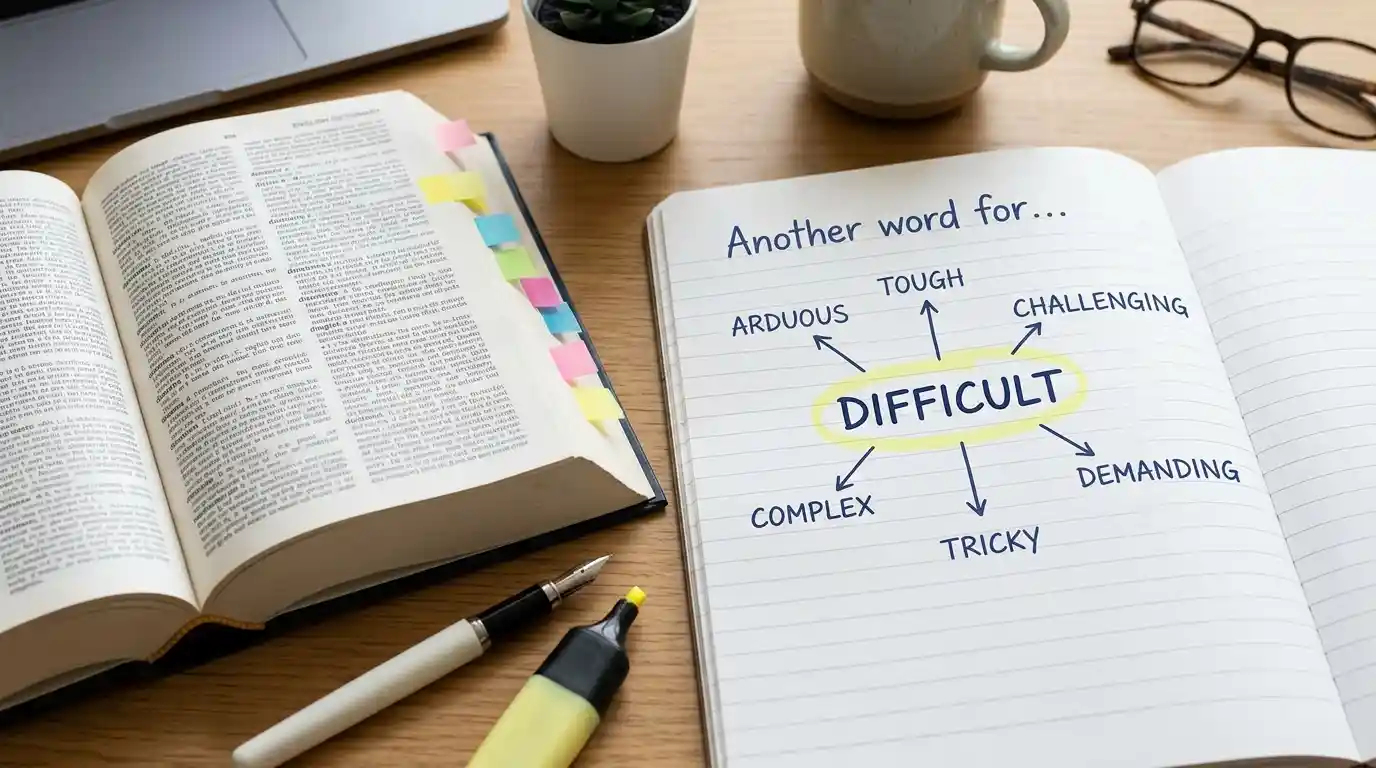
Another word for difficult is hard. Other common choices are tough, challenging, tricky, and demanding. The best choice depends on what makes something difficult. A task can take a lot of effort, a problem can be confusing, a time in your life can be painful, or a person can be hard to deal with.
This article covers each of those areas: effort, complexity, fear or pressure, hardship, and people and behavior.
Quick list: hard, tough, challenging, tricky, demanding, complicated, arduous, daunting, trying, complex
Below you will find 30 alternatives with meanings, IPA pronunciation, usage notes, and example sentences. Some are direct synonyms, and others only fit certain contexts. Each usage note says which is which.
At a Glance: Difficult Synonyms and Related Alternatives
| Alternative | Part of Speech | Meaning | Register / Tone | Ideal Context |
| hard | adjective | not easy to do or understand | neutral, everyday | general use |
| tough | adjective | hard and needing strength or determination | informal to neutral | decisions, jobs, situations |
| challenging | adjective | testing your skill or ability | neutral, often positive | work, school, goals |
| tricky | adjective | needing care because of hidden problems | informal | small problems, delicate tasks |
| demanding | adjective | needing a lot of time, effort, or attention | neutral | jobs, schedules, people |
| complicated | adjective | having many parts that are hard to follow | neutral | rules, plans, relationships |
| arduous | adjective | needing great effort over time | formal | long journeys, climbs, tasks |
| daunting | adjective | seeming hard enough to cause worry | neutral to formal | large or frightening tasks |
| trying | adjective | hard to bear or testing patience | neutral to formal | times, experiences, people |
| thorny | adjective | full of problems or disagreement | neutral to formal | issues, debates, questions |
Which Word Should You Use?
| If you want to… | Use | Why |
| Say something is not easy in everyday speech | hard | It is the simplest and most common alternative. |
| Describe a task that tests your skills in a fair or positive way | challenging | It suggests effort that can lead to growth. |
| Describe a problem with a hidden catch | tricky | It points to a small trap or a delicate point. |
| Describe tiring physical effort | strenuous or grueling | Both stress how much energy is used. |
| Describe something with too many parts to follow | complicated | The difficulty comes from the structure, not the effort. |
| Describe a slow, detailed job that takes patience | laborious | It stresses long, careful work. |
| Describe an issue that is awkward to handle | thorny | It fits debates, questions, and disagreements. |
| Describe a person who is hard to deal with | awkward or uncooperative | These describe behavior, not task difficulty. |
Exploring the Multiple Meanings of “Difficult”
1. Not Easy to Do
- Meaning: Needing effort, skill, or time to do or achieve.
- Explanation: This is the main sense of the word. It applies to tasks, jobs, goals, and actions. Hard and challenging are the closest matches here.
- Example: Learning to swim as an adult can be difficult at first.
2. Hard to Understand or Solve
- Meaning: Not easily understood, explained, or answered.
- Explanation: Here the problem is the mind, not the body. Questions, ideas, and puzzles can all be difficult in this way. Complicated, tricky, and baffling often fit.
- Example: The last question on the exam was too difficult for most students.
3. Full of Trouble or Hardship
- Meaning: Causing stress, pain, or problems.
- Explanation: This sense describes periods of life and situations rather than tasks. It is often used for times, years, and conditions. Rough, trying, and harsh are common alternatives.
- Example: The family went through a difficult year after the factory closed.
4. Hard to Deal With or Please
- Meaning: Describing a person or behavior that is not easy to manage, satisfy, or work with.
- Explanation: In this sense, difficult describes how a person acts, not how hard a task is. The use for people goes back to the 1580s. A “difficult customer” is not a hard customer in the same way, because hard describes a person as harsh or unfeeling.
- Example: The manager was known as a difficult boss who changed his mind constantly.
5. Hard to Move Through or Reach
- Meaning: Describing a place, route, or set of physical conditions that is hard to travel through or work in.
- Explanation: This is a physical extension of the first sense. It often appears with terrain, access, and weather. Rough, harsh, and arduous fit here.
- Example: Rescue teams had difficult conditions to deal with because of the storm.
Sources: Dictionary.com; Etymonline; Merriam-Webster; Collins English Dictionary.
Analyzing 30 Difficult Alternatives in Detail
Some of these words are direct synonyms of difficult, while others are related alternatives that only fit certain contexts.
Core Everyday Alternatives
1. Hard
IPA: US /hɑːrd/ · UK /hɑːd/
Definition: Not easy to do, understand, or deal with.
- Usage: This is the closest everyday synonym for difficult. It is neutral and works in almost any sentence. It also has other meanings, such as firm or harsh, so the context needs to be clear.
- Example: It was hard to hear the speaker from the back of the room.
2. Tough
IPA: /tʌf/ (US and UK)
Definition: Hard to do or deal with, often needing strength or determination.
- Usage: This is a close synonym in informal and neutral speech. It stresses pressure and strain, as in “a tough week.” It can also describe strong people, which difficult does not.
- Example: Choosing between the two job offers was a tough decision.
3. Challenging
IPA: /ˈtʃælɪndʒɪŋ/ (US and UK)
Definition: Testing your ability, skill, or determination.
- Usage: This is a direct synonym with a more positive or polite tone. It suggests the task is hard but worth doing. People also use it to soften difficult, as in “a challenging child.”
- Example: The course is challenging, but the teachers give a lot of support.
4. Tricky
IPA: /ˈtrɪki/ (US and UK)
Definition: Needing care or skill because of hidden problems or delicate points.
- Usage: This is a direct synonym in informal speech, but it suggests a small catch, not a huge effort. Use it for puzzles, parking, or sensitive topics.
- Example: Splitting the bill fairly can be tricky when people order different things.
5. Demanding
IPA: US /dɪˈmændɪŋ/ · UK /dɪˈmɑːndɪŋ/
Definition: Needing a lot of time, effort, or attention.
- Usage: This is a related alternative, not an exact synonym. It describes what a job, schedule, or person asks of you, not if the task is hard to understand.
- Example: She has a demanding job that often keeps her at the office until late.
Effort and Endurance
6. Arduous
IPA: US /ˈɑːrdʒuəs/ · UK /ˈɑːdjuəs/
Definition: Needing great effort and endurance over a long time.
- Usage: This is a formal alternative for tasks, journeys, and climbs. It is not used for people. It suggests length and effort, not confusion.
- Example: The explorers made an arduous trek across the mountains.
7. Strenuous
IPA: /ˈstrɛnjuəs/ (US and UK)
Definition: Needing a lot of physical or mental energy.
- Usage: This is a related alternative that fits activity and exercise better than problems. A strenuous task uses a lot of energy, but it may not be hard to understand.
- Example: The doctor told him to avoid strenuous exercise for a few weeks.
8. Laborious
IPA: /ləˈbɔːriəs/ (US and UK)
Definition: Needing a lot of work and patience, often slow and tiring.
- Usage: This is a related alternative that stresses slow, detailed effort, and it can suggest boredom. It is not suitable for a hard question or a tricky idea.
- Example: Copying the old records by hand was a laborious process.
9. Grueling
IPA: /ˈɡruːəlɪŋ/ (US and UK)
Definition: Extremely tiring and punishing.
- Usage: This is a stronger alternative than difficult. It fits races, schedules, and long ordeals. British English often spells it gruelling.
- Example: The team finished a grueling week of travel and games.
10. Onerous
IPA: US /ˈɑːnərəs/ · UK /ˈɒnərəs/
Definition: Causing a heavy burden or great trouble.
- Usage: This is a formal, related alternative. It is common in legal and business writing for duties, rules, costs, and conditions. It does not mean physically hard.
- Example: The new rules placed an onerous burden on small businesses.
Complexity and Confusion
11. Complicated
IPA: US /ˈkɑːmplɪkeɪtɪd/ · UK /ˈkɒmplɪkeɪtɪd/
Definition: Having many parts or details that make it hard to understand or deal with.
- Usage: This is a related alternative. The difficulty comes from the number of parts, not from effort. It is common for rules, plans, and relationships.
- Example: The instructions were so complicated that we had to read them twice.
12. Complex
IPA: US /kɑːmˈplɛks/ · UK /ˈkɒmpleks/
Definition: Made of many connected parts; not simple.
- Usage: This is a related alternative and not a full synonym. Something complex is not always hard to do. It can be neutral or even admiring. Use it for systems, issues, and ideas.
- Example: The human brain is a complex organ.
13. Intricate
IPA: /ˈɪntrɪkət/ (US and UK)
Definition: Having many small, detailed parts that fit together in a complicated way.
- Usage: This is a related alternative, often with a tone of admiration. It fits patterns, designs, and plots. It does not always suggest difficulty.
- Example: The watchmaker repaired the intricate mechanism with tiny tools.
14. Thorny
IPA: US /ˈθɔːrni/ · UK /ˈθɔːni/
Definition: Full of difficulties or points of disagreement.
- Usage: This is a figurative alternative that comes from the plant’s sharp thorns. It fits issues, questions, and debates, usually ones that are awkward to handle.
- Example: The council faced a thorny question about who should pay for the road.
15. Baffling
IPA: /ˈbæflɪŋ/ (US and UK)
Definition: So confusing that it is hard to understand or explain.
- Usage: This is a related alternative. It describes the feeling of being puzzled, not the effort needed. It fits mysteries, behavior, and strange results.
- Example: The detective found the case baffling because no clues pointed to anyone.
Intimidating and Formal Alternatives
16. Formidable
IPA: US /ˈfɔːrmɪdəbəl/ · UK /ˈfɔːmɪdəbəl/
Definition: Causing fear or respect because of great size, power, or difficulty.
- Usage: This is a formal, related alternative. It suits opponents, obstacles, and large challenges. It adds a sense of power.
- Example: The team faced the formidable task of rebuilding the bridge in one month.
17. Daunting
IPA: /ˈdɔːntɪŋ/ (US and UK)
Definition: Seeming hard enough to make you feel worried or afraid.
- Usage: This is a related alternative that stresses how the task looks or feels. Something can seem daunting before you start and turn out to be manageable.
- Example: Moving to a new country alone is a daunting step.
18. Taxing
IPA: /ˈtæksɪŋ/ (US and UK)
Definition: Putting heavy strain on your strength, mind, or patience.
- Usage: This is a neutral to formal alternative. It stresses tiredness and strain, not complexity. It fits work, travel, and stressful days.
- Example: Teaching all day can be mentally taxing.
19. Exacting
IPA: /ɪɡˈzæktɪŋ/ (US and UK)
Definition: Demanding great care, accuracy, or high standards.
- Usage: This is a related, formal alternative. It describes work with strict standards, or people who expect them. It is not a general synonym for difficult.
- Example: Surgery is exacting work that leaves no room for small mistakes.
20. Herculean
IPA: US /ˌhɜːrkjəˈliːən/ · UK /ˌhɜːkjʊˈliːən/
Definition: Needing extraordinary strength or effort, like the tasks of the Greek hero Hercules.
- Usage: This is a literary or formal alternative for very large efforts. It is most often used in “a herculean task” or “herculean effort.” It is too strong for ordinary difficulty.
- Example: Clearing the town after the flood was a herculean effort.
Hardship and Bad Conditions
21. Trying
IPA: /ˈtraɪɪŋ/ (US and UK)
Definition: Hard to bear and testing your patience.
- Usage: This is a related alternative for periods, experiences, and sometimes people. It points to emotional strain more than skill or effort.
- Example: It has been a trying few weeks for everyone at the hospital.
22. Rough
IPA: /rʌf/ (US and UK)
Definition: Hard or unpleasant to go through.
- Usage: This is an informal alternative for a bad period or experience, as in “a rough week.” It has many other meanings, such as not smooth, so the context matters.
- Example: He had a rough start at the new school.
23. Troublesome
IPA: /ˈtrʌbəlsəm/ (US and UK)
Definition: Causing worry, annoyance, or problems.
- Usage: This is a related alternative. Something troublesome keeps causing problems, which is different from being hard to do. It fits things like a recurring injury or a naughty pet.
- Example: The troublesome engine broke down again on the way home.
24. Adverse
IPA: US /ædˈvɜːrs/ · UK /ˈædvɜːs/
Definition: Unfavorable, harmful, or unpleasant.
- Usage: This is a formal, related alternative. It describes conditions and effects, such as weather, reactions, or markets. It is not used for tasks or people.
- Example: The flight was delayed because of adverse weather.
25. Harsh
IPA: US /hɑːrʃ/ · UK /hɑːʃ/
Definition: Unpleasantly severe or hard to endure.
- Usage: This is a related alternative for conditions, climates, and treatment. It stresses severity, not mental effort.
- Example: The settlers struggled through a harsh winter.
People and Behavior
26. Awkward
IPA: US /ˈɔːkwərd/ · UK /ˈɔːkwəd/
Definition: Hard to deal with, or causing embarrassment or discomfort.
- Usage: This is a related alternative. It describes people and situations that are uncomfortable to handle. It can also mean clumsy, which is a different sense.
- Example: He asked an awkward question at the meeting, and nobody wanted to answer.
27. Fussy
IPA: /ˈfʌsi/ (US and UK)
Definition: Hard to please and too concerned about small details.
- Usage: This is an informal, mild alternative for people, especially children and eaters. It covers only the “hard to please” sense of difficult.
- Example: My nephew is a fussy eater and refuses most vegetables.
28. Uncooperative
IPA: US /ˌʌnkoʊˈɑːpərətɪv/ · UK /ˌʌnkəʊˈɒpərətɪv/
Definition: Unwilling to help or work with others.
- Usage: This is a related alternative that describes behavior only. It does not fit tasks or problems.
- Example: The witness was uncooperative and refused to answer most questions.
29. Obstinate
IPA: US /ˈɑːbstɪnət/ · UK /ˈɒbstɪnət/
Definition: Refusing to change your opinion or course of action, even when given good reasons.
- Usage: This is a related alternative for people and attitudes. It points to stubbornness as the reason someone is hard to deal with. It is more formal than stubborn.
- Example: The obstinate owner refused to sell, even for a high price.
30. Unmanageable
IPA: /ʌnˈmænɪdʒəbəl/ (US and UK)
Definition: Impossible or very hard to control or handle.
- Usage: This is a stronger, related alternative. It suggests the situation has gone beyond what someone can handle. It fits workloads, crowds, and behavior.
- Example: The crowd became unmanageable after the gates opened.
Sources: Dictionary.com; Merriam-Webster; Collins English Dictionary; Etymonline.
Difficult vs. Hard vs. Challenging vs. Tough
These four words are often treated as the same, but they differ in tone and focus.
| Word | Main Idea | Typical Tone | Example |
| difficult | not easy; can also describe people who are hard to deal with | neutral to slightly formal | a difficult customer |
| hard | not easy; also firm or harsh | neutral, everyday | a hard test |
| challenging | tests your skill, often in a useful way | neutral to positive | a challenging project |
| tough | needs strength or determination; often about pressure | informal to neutral | a tough decision |
The biggest difference appears with people. A difficult person is hard to get along with. A hard person is harsh or unfeeling. Challenging is often used as a polite way to say difficult, especially in work and school. Tough can describe both a hard situation and a strong person.
Sources: Dictionary.com; Merriam-Webster; Collins English Dictionary.
Difficult and Opposite/Paired Word Pairs
| Word | Paired Word | Note |
| difficult | easy | The most direct opposite. Both describe how much effort something needs. |
| hard | easy | A common everyday pair, as in “easy or hard?” |
| complicated | simple | The opposite when difficulty comes from many parts. |
| tricky | straightforward | Describes something with no hidden catch. |
| demanding | undemanding | Used for jobs, schedules, and tasks that need little effort. |
| challenging | manageable | Used when a task can be handled without great strain. |
| arduous | effortless | A formal, strong contrast. |
| awkward | easygoing | Describes people who are easy to deal with. |
The best opposite depends on the sense. Easy works for most tasks, but simple and straightforward fit better for ideas and instructions. For people, easygoing or cooperative is more natural. Easy and difficult are also linked in origin, since difficult comes from a Latin word meaning “not easy.”
Sources: Merriam-Webster; Collins English Dictionary; Etymonline.
Common Word Partners of “Difficult”
| Pattern | Common Partners | Example |
| difficult + noun | decision, question, task, choice, situation, conversation, time, terrain | They had a difficult conversation about money. |
| difficult + person | child, boss, customer, teenager, patient | The shop owner dealt calmly with a difficult customer. |
| adverb + difficult | extremely, increasingly, particularly, notoriously, very | The exam was notoriously difficult. |
| difficult to + verb | say, understand, explain, find, imagine, believe | It is difficult to explain how it felt. |
| find it difficult to | concentrate, sleep, relax, decide | I find it difficult to concentrate in noisy rooms. |
| make it difficult for | someone to + verb | The heavy rain made it difficult for drivers to see. |
| difficult for + person | me, her, students, beginners | The lesson was difficult for beginners. |
Sources: Collins English Dictionary; Merriam-Webster; Dictionary.com.
Idiomatic Phrases Featuring “Difficult”
Difficult has very few true idioms. The more fixed idioms about difficulty usually use hard or tough, as in “a tough act to follow.” The expressions below are established ways of using the word, and some are variants of phrases that normally use hard.
1. Make things difficult for someone
- Meaning: To cause problems for someone, on purpose or by accident.
- Example: The new rules make things difficult for people who work night shifts.
2. Have a difficult time
- Meaning: To struggle with something or go through a hard experience.
- Example: She had a difficult time adjusting to the cold weather.
3. A difficult pill to swallow
- Meaning: Something unpleasant that is hard to accept. This is a variant of the more established expression “a hard pill to swallow” or “a bitter pill to swallow.”
- Example: Losing the final by one point was a difficult pill to swallow.
4. Difficult to come by
- Meaning: Hard to find or get. This is a variant of the more common “hard to come by.”
- Example: Good tickets are difficult to come by on the day of the concert.
Sources: Merriam-Webster; Collins English Dictionary.
Word Formation of “Difficult”
Etymology & Structure
Difficult is a back-formation from difficulty, meaning it was formed by shortening the older noun. Difficulty comes from Anglo-French difficulté and Latin difficultas. This comes from Latin difficilis, “hard.” That word combines dis- (“not, away from”) and facilis (“easy to do”), which comes from facere, “to do.” Etymonline describes difficult as an unetymological back-formation because it does not follow the usual Latin pattern.
Date and History
Etymonline dates difficult to about 1400, with the meaning “not easy, requiring effort; troublesome, arduous.” Dictionary.com gives the range 1350–1400 for its first record in Middle English. The noun difficulty is older, dating to the late 14th century. The use of difficult for people, meaning “hard to please,” appears from the 1580s.
Word Class Variations
- Adjective: difficult
- Noun: difficulty (plural: difficulties); difficultness (rare)
- Adverb: difficultly (rare; “with difficulty” is far more common)
- Verb: There is no standard verb form in modern English.
Sources: Etymonline; Dictionary.com.
Common Word-Choice Mistakes
- The test was difficult to me. → The test was difficult for me.
- I have a difficult to sleep. → I have difficulty sleeping.
- a difficulty question → a difficult question (adjective, not noun).
- It was difficult that I wake up early. → It was difficult for me to wake up early.
- an arduous child → a difficult child (arduous describes tasks and journeys, not people).
- a grueling puzzle → a tricky puzzle (grueling means punishing and tiring, not clever).
- She faced many difficult at work. → She faced many difficulties at work.
Frequently Asked Questions
What is the closest synonym for difficult?
Hard is the closest everyday synonym. Tough and challenging are also close, depending on the context.
What is the difference between difficult and hard?
They overlap in most uses, but hard is more common in everyday speech and also means firm or harsh. With people, difficult means hard to deal with, while hard can mean unfeeling.
What is the difference between difficult and challenging?
Challenging usually sounds more positive. It suggests a task that tests your skill and may be rewarding, while difficult is more neutral or negative.
What is a formal alternative to difficult?
Arduous, onerous, taxing, and formidable are formal options. Choose by meaning: arduous for effort, onerous for burdens, and formidable for something powerful or intimidating.
What word means difficult because it has many parts?
Complicated, complex, and intricate fit best. Complicated usually suggests trouble, while complex and intricate can be neutral or admiring.
Is complex the same as difficult?
No. Something complex has many connected parts, but it may not be hard to do. A complex machine can be easy to use.
Can difficult describe people?
Yes. A difficult person is hard to please, manage, or work with. Awkward, fussy, uncooperative, and obstinate are more specific alternatives.
What is the opposite of difficult?
Easy is the most direct opposite. Simple and straightforward are common opposites for confusing tasks or instructions.
Is “difficultly” a real word?
It exists but is rare. Most speakers say “with difficulty,” as in “She walked with difficulty.”
What is a strong word for extremely difficult?
Herculean, grueling, formidable, and daunting all add strength. Each stresses something different: huge effort, exhaustion, power, or fear.
Conclusion
The closest everyday alternatives to difficult are hard, tough, challenging, and tricky. They work in most situations and are easy to understand. Demanding, complicated, and trying are also common, but each points to a narrower kind of difficulty.
Context matters because difficult covers several different ideas. Effort, confusion, fear, hardship, and bad behavior each call for a different word. Arduous does not fit a confusing question, and complicated does not fit a long hike. Words for people, such as awkward or obstinate, do not fit tasks at all.
To choose the right word, first ask what makes the thing difficult. To choose the right word, think about what makes the thing difficult. For long, tiring work, try arduous or strenuous. For something with many moving parts, complicated or complex fits better. When a task looks frightening, daunting is the word. For a person, pick a word that names how they act, such as awkward, fussy, or obstinate. When in doubt, hard is a safe choice.

Hi, I’m Usam Varya, a passionate content writer and author with 3 years of experience in writing clear, engaging, and informative content. Through my website, ideamoonhavan.com, I aim to share useful information, fresh ideas, and well-researched articles that help readers learn something new. I believe in creating simple, reader-friendly content that is both valuable and easy to understand. My goal is to provide helpful insights, answer readers’ questions, and make every visit to my website worthwhile.