
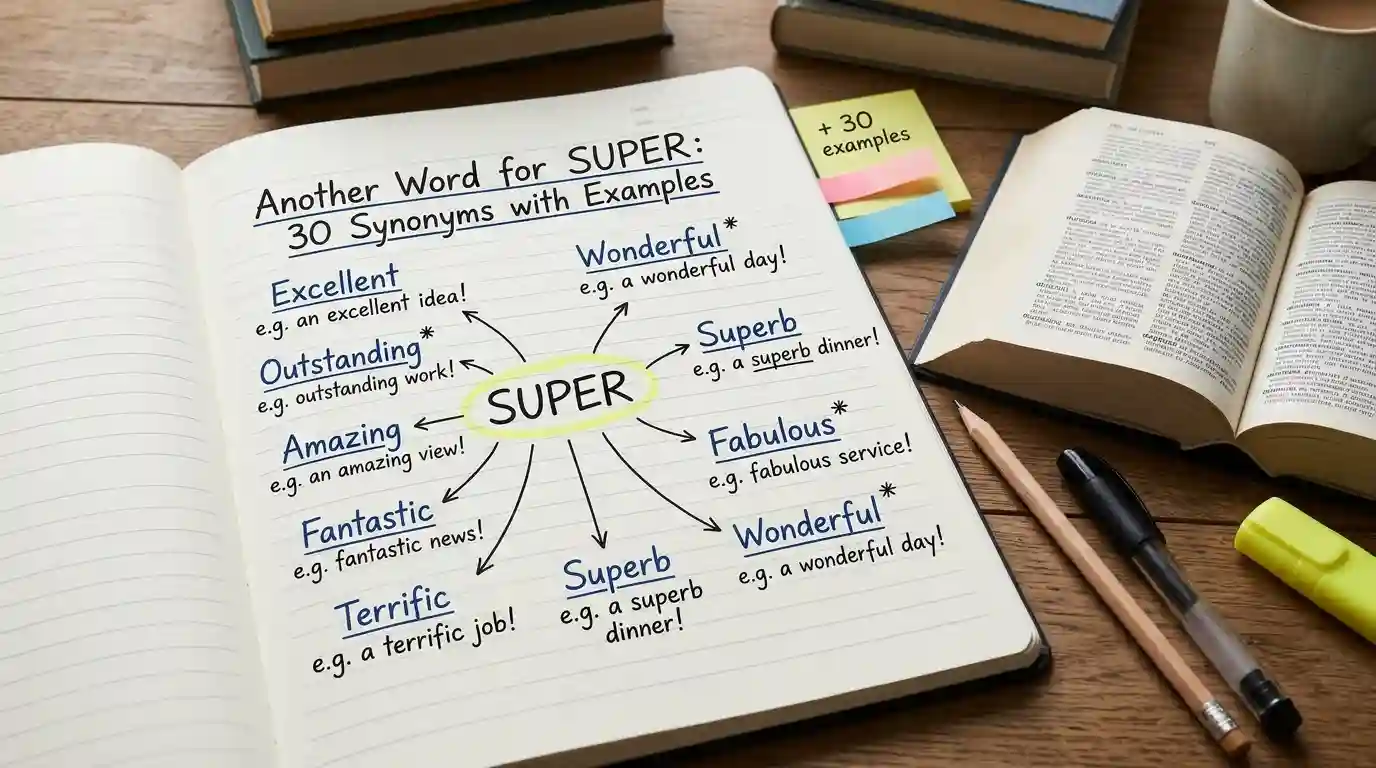
Great and excellent are the closest everyday words for super. For example, you can say “a great day” instead of “a super day.” Very and really also work when super means “very.”
Super can praise something, add force to a word, or name a building manager. So the best choice depends on meaning and context. First, decide which sense you need.
Quick list: great, excellent, fantastic, wonderful, awesome, superb, brilliant, very, really, extremely
This guide covers 30 alternatives. Each one has a meaning, IPA, a usage note, and an example. You can also see which words fit casual or formal writing.
At a Glance: Super Synonyms and Related Alternatives
| Alternative | Part of Speech | Meaning | Register / Tone | Ideal Context |
| Great | Adjective | Very good | Neutral, friendly | Everyday praise |
| Excellent | Adjective | Of high quality | Neutral to formal | Work, school, reviews |
| Fantastic | Adjective | Extremely good | Warm, informal | Good news, events |
| Awesome | Adjective | Thrilling and excellent | Casual | Texts, chats |
| Superb | Adjective | Of the highest quality | Formal | Skill, food, art |
| Brilliant | Adjective | Very clever or excellent | Informal | Ideas, British speech |
| Very | Adverb | To a high degree | Neutral | Any adjective |
| Really | Adverb | To a high degree | Casual | Speech, emails |
| Extremely | Adverb | To a very high degree | Neutral to formal | Strong emphasis |
| Superintendent | Noun | Building or site manager | Formal | Apartments, schools |
Which Word Should You Use?
| If you want to… | Use | Why |
| Praise something in a casual chat | great | It is friendly and fits most settings. |
| Praise work in a formal review | excellent | It sounds polished and clear. |
| Show strong joy about good news | fantastic | It carries energy and warmth. |
| Praise skill or quality in writing | superb | It is formal and strong. |
| Sound young and relaxed | awesome | People use it often in speech and texts. |
| Add force to an adjective | very | It is plain and works everywhere. |
| Add a casual boost to a word | really | It sounds natural in speech. |
| Name the person who runs a building | superintendent | It is the full form of the noun super. |
Exploring the Multiple Meanings of “Super”
1. Excellent or First-Rate
- Meaning: Very good or of high quality.
- Explanation: This is the main modern sense. People use it for casual praise.
- Example: We had a super weekend at my aunt’s lake house.
2. Very or Extremely
- Meaning: To a high degree.
- Explanation: This informal use acts like the prefix super-. It comes before an adjective.
- Example: The test was super easy for most students.
3. Building Manager
- Meaning: A person who looks after an apartment building.
- Explanation: Dictionary.com lists this as an informal noun sense. Residents often call this person “the super.”
- Example: Our super fixed the leaking pipe on Monday.
4. Retirement Savings
- Meaning: Short for superannuation, a retirement savings plan.
- Explanation: Wiktionary lists this informal noun for Australia and New Zealand. Workers use it when they talk about pay.
- Example: My employer pays money into my super every month.
5. High-Grade Fuel
- Meaning: Petrol with a high octane rating.
- Explanation: Collins lists this noun sense. It has nothing to do with praise.
- Example: The old sports car runs best on super.
Sources: Dictionary.com; Collins English Dictionary; Merriam-Webster; Wiktionary
Analyzing 30 Super Alternatives in Detail
Some alternatives are direct synonyms, while others fit only one context.
Core Everyday Synonyms
1. Great
IPA: /ɡreɪt/ (US and UK)
Definition: Means very good or of high quality. It also shows strong approval in daily talk.
- Usage: Great is the safest everyday swap for super. It also works in most casual and polite settings.
- Example: We had a great time at the beach yesterday.
2. Excellent
IPA: /ˈɛksələnt/ (US and UK)
Definition: Means very good and of a high standard. It also shows praise that sounds a bit serious.
- Usage: Excellent fits school, work, and reviews. However, super sounds warmer and more casual.
- Example: She did an excellent job on the science project.
3. Fantastic
IPA: /fænˈtæstɪk/ (US and UK)
Definition: Means extremely good, often in a thrilling way. It also has an older meaning of strange or unreal.
- Usage: Fantastic matches the happy tone of super. For example, people use it for good news.
- Example: The pizza at that little shop was fantastic.
4. Wonderful
IPA: US /ˈwʌndərfəl/ · UK /ˈwʌndəfəl/
Definition: Means very pleasing and full of joy. It also shows warm, heartfelt praise.
- Usage: Wonderful is gentler than super. It suits kind comments, for example about a person or a day.
- Example: Thank you for such a wonderful dinner tonight.
5. Terrific
IPA: /təˈrɪfɪk/ (US and UK)
Definition: Means very good or very great. It also can mean very large or strong, as in a terrific noise.
- Usage: Terrific is an upbeat synonym for super. However, its older meaning of “frightening” is rare today.
- Example: Your new haircut looks terrific on you today.
6. Awesome
IPA: /ˈɔːsəm/ (US and UK)
Definition: Means excellent in a thrilling way. It also began as a word for deep awe.
- Usage: Awesome is casual and common in speech. It also fits texts and chats.
- Example: That concert we saw last night was awesome.
Formal and Polished Alternatives
7. Superb
IPA: US /suːˈpɜːrb/ · UK /suːˈpɜːb/
Definition: Means of the very highest quality. It also shows grand skill or beauty.
- Usage: Superb is more formal than super. Merriam-Webster also says the two words are related but separate.
- Example: The chef served a superb meal to every guest.
8. Outstanding
IPA: /aʊtˈstændɪŋ/ (US and UK)
Definition: Means much better than others. It also can mean unpaid, as in an outstanding bill.
- Usage: Outstanding suits work, grades, and awards. However, check the context so it does not read as “unpaid.”
- Example: Her outstanding grades earned her a school award.
9. Exceptional
IPA: /ɪkˈsɛpʃənəl/ (US and UK)
Definition: Means far above the normal level. It also can mean rare or unusual.
- Usage: Exceptional is formal and strong. For example, a boss may use it in a review.
- Example: The team gave exceptional service during the storm.
10. Splendid
IPA: /ˈsplɛndɪd/ (US and UK)
Definition: Means very fine and impressive. It also suggests a bright, grand look.
- Usage: Splendid feels a little old-fashioned. Still, many people use it in polite talk.
- Example: We had a splendid view from the top floor.
11. Magnificent
IPA: /mæɡˈnɪfɪsənt/ (US and UK)
Definition: Means grand, rich, and very impressive. It also fits large or beautiful things.
- Usage: Magnificent is stronger than super. In fact, it often praises places, art, or big efforts.
- Example: The magnificent palace stood high above the river.
12. Superior
IPA: US /səˈpɪriər/ · UK /suːˈpɪəriə/
Definition: Means higher in rank or better in quality. It also names a person of higher rank.
- Usage: Superior is a related alternative, not a casual synonym. It also compares things, so it often needs “to.”
- Example: This brand is superior to the cheaper one.
Casual and Slang Alternatives
13. Brilliant
IPA: /ˈbrɪljənt/ (US and UK)
Definition: Means very bright or very clever. It is also a common British word for excellent.
- Usage: Brilliant is a strong match for super in British talk. In fact, it can also praise smart ideas.
- Example: What a brilliant idea for the class party!
14. Fab
IPA: /fæb/ (US and UK)
Definition: Is a short form of fabulous. It also means great in a light, fun way.
- Usage: Fab is short slang. However, it can feel retro, so use it with care.
- Example: Your new shoes look absolutely fab with that dress.
15. Ace
IPA: /eɪs/ (US and UK)
Definition: Means excellent or highly skilled. It also names a top card or a top expert.
- Usage: Ace is casual slang. For example, a friend might call a trip ace.
- Example: Our new neighbor is an ace at fixing bikes.
16. Cool
IPA: /kuːl/ (US and UK)
Definition: Means excellent or admired in a relaxed way. It also means a little cold.
- Usage: Cool is a casual reply to good news. However, it is milder than super.
- Example: Wow, your new bike is really cool, Sam.
17. Epic
IPA: /ˈɛpɪk/ (US and UK)
Definition: Means grand, huge, or very impressive. It also names a long story or poem.
- Usage: Epic is slang for something amazing. However, it is a related word, not an exact match.
- Example: Our trip to the mountains was truly epic.
Alternatives for the “Very” Sense
18. Very
IPA: /ˈvɛri/ (US and UK)
Definition: Means to a high degree. It also adds force to an adjective.
- Usage: Very is the plain swap when super means “very.” For example, “super tired” becomes “very tired.”
- Example: The soup was very hot, so I waited.
19. Really
IPA: US /ˈriːli/ · UK /ˈrɪəli/
Definition: Means in truth or to a high degree. It also adds a casual tone.
- Usage: Really is a friendly swap for super in speech. Still, writers often pick a stronger word.
- Example: I am really happy with my new job.
20. Extremely
IPA: /ɪkˈstriːmli/ (US and UK)
Definition: Means to a very high degree. It also shows strong force.
- Usage: Extremely is stronger than very. In fact, it fits both formal and everyday writing.
- Example: The road to school was extremely icy this morning.
21. Incredibly
IPA: /ɪnˈkrɛdəbli/ (US and UK)
Definition: Means to a surprising degree. It also shows that something is hard to believe.
- Usage: Incredibly adds a sense of surprise. For example, it suits strong praise or strong shock.
- Example: The mountain view was incredibly beautiful at sunrise.
22. Highly
IPA: /ˈhaɪli/ (US and UK)
Definition: Means to a great degree. It also pairs with only some words.
- Usage: Highly is a related alternative. However, it works with set words like “unlikely” or “skilled.”
- Example: She is a highly skilled nurse at our clinic.
23. Truly
IPA: /ˈtruːli/ (US and UK)
Definition: Means in a real way or to a full degree. It also adds heartfelt force.
- Usage: Truly lifts the feeling of an adjective. For example, “truly kind” sounds sincere.
- Example: The teacher was truly kind to every new student.
Top-Grade and Rank Alternatives
24. Supreme
IPA: /suːˈpriːm/ (US and UK)
Definition: Means highest in rank, power, or quality. It also shows the very top level.
- Usage: Supreme is formal and strong. In fact, it matches the “highest degree” sense of super.
- Example: The champion showed supreme skill in the final round.
25. First-Rate
IPA: US /ˌfɜːrst ˈreɪt/ · UK /ˌfɜːst ˈreɪt/
Definition: Means of the best class. It also suggests top skill or quality.
- Usage: First-rate echoes the early sense of super as “top grade.” It also sounds a bit formal.
- Example: The hotel offers first-rate service to every guest.
26. Top-Notch
IPA: US /ˌtɑːp ˈnɑːtʃ/ · UK /ˌtɒp ˈnɒtʃ/
Definition: Means of the highest quality. It also sounds casual and warm.
- Usage: Top-notch is informal praise for work or skill. For example, people use it for service.
- Example: Our new dentist is top-notch and very gentle.
27. Premier
IPA: US /prɪˈmɪr/ · UK /ˈprɛmiə/
Definition: Means first in rank or importance. It also names a head of government in some places.
- Usage: Premier is a related alternative. However, it fits titles and ranks better than casual praise.
- Example: This is the premier hiking trail in the region.
Alternatives for the Building-Manager Sense
28. Superintendent
IPA: /ˌsuːpərɪnˈtɛndənt/ (US and UK)
Definition: Means a person who manages a building or place. It also names a school or police leader.
- Usage: Super is the short, informal form of this noun. However, this is a different sense from “excellent.”
- Example: The superintendent fixed the broken heater this morning.
29. Supervisor
IPA: US /ˈsuːpərvaɪzər/ · UK /ˈsuːpəvaɪzə/
Definition: Means a person who watches and guides workers. It also names a person who guides a student.
- Usage: Supervisor is a related noun sense. Dictionary.com also lists super as its informal short form.
- Example: Her supervisor praised the team after the project.
30. Caretaker
IPA: US /ˈkɛrteɪkər/ · UK /ˈkeəteɪkə/
Definition: Means a person who looks after a building. It also names someone who cares for others.
- Usage: Caretaker is a related word for the building sense. Still, it is more common in British English.
- Example: The school caretaker locks the gates every evening.
Sources: Merriam-Webster; Collins English Dictionary; Dictionary.com; Etymonline
Super vs. Superb vs. Superior
| Word | Part of Speech | Tone | Best Use |
| Super | Adjective, adverb, noun | Casual | Friendly praise or “very” |
| Superb | Adjective | Formal | Skill, food, art |
| Superior | Adjective, noun | Formal | Comparing quality or rank |
These three words look alike, but they work in different ways. Super is casual and can also mean “very.” Superb praises top quality, and superior compares one thing with another.
Merriam-Webster says superb is related to super but is a separate word. Superior comes from a Latin word for “higher.” So the spelling link is real, but the uses differ.
Sources: Merriam-Webster; Etymonline; Dictionary.com
Super and Opposite/Paired Word Pairs
| Word | Paired Word | Note |
| super | awful | A strong informal contrast. |
| super | lousy | Casual and blunt. |
| super | so-so | Shows an average result. |
| super- | sub- | Prefixes meaning “above” and “below.” |
| super- | under- | Another natural prefix contrast. |
Super has no single exact opposite. However, informal words like awful and lousy give a clear contrast. The prefix pair super- and sub- is also useful, because it shows position above or below.
Sources: Merriam-Webster; Dictionary.com; Etymonline
Common Word Partners of “Super”
| Pattern | Common Partners | Example |
| super + adjective | easy, cute, happy, fast | The setup was super easy. |
| super + noun (praise) | job, idea, day | That was a super idea. |
| super + noun (extra) | fan, sale | My brother is a super fan of that team. |
| exclamation | “Super!” “That’s super.” | You lost your keys? Super. |
| building + super | building super, apartment super | Call the building super about the leak. |
Sources: Merriam-Webster; Dictionary.com; Collins English Dictionary
Idiomatic Phrases Featuring “Super”
Super has few true idioms. The items below are established expressions, not deep idioms.
1. Super-Duper
- Meaning: Extremely good. It is a playful, informal phrase.
- Example: We had a super-duper day at the fair.
2. Supersize
- Meaning: To make something much bigger than usual.
- Example: He decided to supersize his lunch order.
3. Super Tuesday
- Meaning: A Tuesday in the US election season when many states hold primaries.
- Example: News shows covered every result on Super Tuesday.
Sources: Merriam-Webster; Dictionary.com
Word Formation of “Super”
Etymology & Structure
Super comes from Latin super, which means “above, over, or beyond.” English first used it as a prefix. The adjective grew out of that prefix.
Date and History
Etymonline records the adjective sense “first-rate, excellent” in 1837. It grew from words like superfine, which marked the top grade of goods. Etymonline also records a noun sense of “person in charge” by the 1580s. The sense of “janitor” dates from about 1935.
Word Class Variations
- Adjective: a super trip
- Adverb (informal): super easy
- Noun (informal): the building super
- Prefix: super-, as in supernova (1934)
Sources: Etymonline; Dictionary.com; Merriam-Webster
Common Word-Choice Mistakes
- Super in a formal essay: use excellent or outstanding.
- Very super: use super or very good.
- More super: use better, because super does not take comparison.
- I had a super for dinner: use supper for the meal.
- Superior than: use superior to.
- Super news is super sad: use very sad news.
Frequently Asked Questions
What is the closest synonym for super?
Great is the closest everyday synonym. Excellent also works in more formal writing.
What is a formal alternative to super?
Superb, outstanding, and exceptional fit formal writing.
Can super mean very?
Yes. In informal speech, super works as an adverb, as in “super easy.”
What is the difference between super and superb?
Superb sounds formal and means of the highest quality. The two words are related but separate.
What is the opposite of super?
Awful, lousy, and poor are natural informal opposites.
Is super the same as superior?
No. Superior compares things, as in “superior to,” while super simply praises.
What does “super” mean in an apartment building?
It means the building superintendent. This informal use is mostly American.
What are some slang alternatives to super?
Awesome, cool, fab, and ace are casual choices.
Is super formal enough for an essay?
Usually not. Pick excellent, outstanding, or very instead.
Which words replace super in the “very” sense?
Very, really, and extremely all work well.
Conclusion
Great and excellent are the closest everyday words for super. Fantastic, wonderful, and awesome add more energy. Very, really, and extremely work when super means “very.”
Context matters most. Super can praise, add force, or name a building manager. So each sense needs a different word.
To choose well, first find the sense. Next, check the tone you need. Finally, pick the word that fits your reader.

Ibadat Fatima is a professional content writer with 3 years of experience in English vocabulary, synonyms, word meanings, and language learning. Through ideamoonhavan.com, she creates clear, accurate, and easy-to-understand content that helps readers expand their vocabulary and communicate in English with confidence.